• Reviewing Literature (Chapter B2)

    Understanding Literature Reviews in Social Research
    (Theoretical Framework)

    A literature review is a crucial part of any social research project. It helps you build a strong foundation for your research by examining what others have already discovered about your topic. Let’s explore why it’s important and how to do it effectively.

    Why Literature Reviews Matter

    1. Discover Existing Knowledge: A literature review helps you understand what’s already known about your research area. This prevents you from repeating work that’s already been done and helps you identify gaps in current research.
    2. Refine Your Research: By reviewing existing literature, you can sharpen your research questions, identify important variables, and develop hypotheses. It also helps you connect theory with practice.
    3. Interpret Your Findings: When you complete your research, the literature review helps you make sense of your results by relating them to previous work.

    What Counts as “Literature”?

    “Literature” isn’t just books and articles. It can include:

    • Academic books and journal articles
    • Theses and conference papers
    • Newspapers and media reports
    • Government documents and reports
    • Online resources

    Each type of source has its strengths and limitations, so it’s important to use a variety of sources.

    How to Review Literature Effectively

    1. Start Broad: Begin with textbooks and general sources to get an overview of your topic.
    2. Search Strategically: Use keywords and subject headings to search library catalogs and online databases. Narrow your focus as you clarify your research questions.
    3. Read with Purpose: As you read, focus on information relevant to your research questions. Take notes on key points and arguments.
    4. Evaluate Critically: Consider the credibility of each source and the strength of its arguments and evidence.
    5. Keep Good Records: Use a system (like bibliographic software or index cards) to track your sources, including notes and your own thoughts.

    Presenting Your Literature Review

    How you present your literature review depends on your project:

    • In a thesis, it’s often a separate, in-depth section.
    • In a research report, it provides context for your study.
    • An annotated bibliography lists sources with brief summaries and evaluations.

    Remember, reviewing literature is an ongoing process throughout your research project. It helps you start your research, refine your approach, and interpret your findings.

    By mastering the art of literature review, you’ll build a solid foundation for your research and contribute more effectively to your field of study.

  • Introduction to Research (Section A)

    I’m excited to introduce you to the fascinating world of social science research! Let’s dive into the fundamental concepts that will shape your journey as budding researchers.

    Unraveling the Mystery of Research

    Ever wondered what sets research apart from everyday curiosity? It’s all about systematic inquiry and rigorous methods[1]. As you embark on your academic journey, you’ll learn to ask questions that go beyond surface-level observations and dig deep into social phenomena.

    The Philosophy Behind the Science

    Prepare to have your mind blown! We’ll explore different ways of understanding the social world, from objectivist approaches that seek universal truths to interpretivist perspectives that embrace multiple realities[1]. You’ll discover how your own experiences and values can shape your research – it’s like being both the scientist and the experiment!

    Data: The Building Blocks of Knowledge

    Get ready to see the world through a new lens! Data isn’t just numbers and statistics; it can be words, gestures, or even objects[1]. You’ll learn to decode these social clues and use them to paint a vivid picture of human behavior and interactions.

    Crafting the Perfect Question

    Think you know how to ask questions? Think again! We’ll teach you the art of formulating research questions that are clear, focused, and capable of uncovering groundbreaking insights[1]. It’s like being a detective, but for social phenomena!

    The Ethical Explorer

    Brace yourself for some serious responsibility! As researchers, we have the power to impact people’s lives. We’ll guide you through the ethical maze, ensuring your research respects and protects participants while pushing the boundaries of knowledge.

    Get ready to challenge your assumptions, sharpen your critical thinking, and embark on an intellectual adventure that will transform the way you see the world. Welcome to the exciting realm of social science research!

    Citations:
    [1] https://www.bol.com/nl/nl/f/research-methods/39340982/

  • Data Analysis (Section D)

    Ever wondered how researchers make sense of all the information they collect? Section D of Matthews and Ross’ book is your treasure map to the hidden gems in data analysis. Let’s embark on this adventure together!

    Why Analyze Data?

    Imagine you’re a detective solving a mystery. You’ve gathered all the clues (that’s your data), but now what? Data analysis is your magnifying glass, helping you piece together the puzzle and answer your burning research questions.

    Pro Tip: Plan Your Analysis Strategy Early!

    Before you start collecting data, decide how you’ll analyze it. It’s like choosing your weapon before entering a video game battle – your data collection method will determine which analysis techniques you can use.

    Types of Data: A Trilogy

    1. Structured Data: The neat freak of the data world. Think multiple-choice questionnaires – easy to categorize and analyze.
    2. Unstructured Data: The free spirit. This could be interviews or open-ended responses – more challenging but often rich in insights.
    3. Semi-structured Data: The best of both worlds. A mix of structured and unstructured elements.

    Crunching Numbers: Statistical Analysis

    For all you number lovers out there, statistical analysis is your playground. Learn to summarize data, spot patterns, and explore relationships between different factors. It’s like being a data detective!

    Thematic Analysis: Finding the Hidden Threads

    This is where you become a storyteller, weaving together themes and patterns from qualitative data. Pro tip: Keep a research diary to track your “Eureka!” moments.

    Beyond the Basics: Other Cool Techniques

    • Narrative Analysis: Decoding the stories people tell
    • Discourse Analysis: Understanding how language shapes reality
    • Content Analysis: Counting words to uncover meaning
    • Grounded Theory: Building theories from the ground up

    Tech to the Rescue: Computers in Data Analysis

    Say goodbye to manual number crunching! Learn about software like SPSS and NVivo that can make your analysis life much easier.

    The Grand Finale: Drawing Conclusions

    This is where you answer the ultimate question: “So what?” What does all this analysis mean, and why should anyone care?

    Remember, data analysis isn’t just about crunching numbers or coding text. It’s about uncovering insights that can change the world. So, are you ready to become a data analysis superhero? Let’s get started!

  • Statistical Analysis (chapter D3)

    As first-year students, you might be wondering why we’re diving into statistics. Trust me, it’s not just about crunching numbers – it’s about unlocking the secrets of society!

    Why Statistical Analysis Matters

    Imagine you’re a detective trying to solve the mysteries of human behavior. That’s essentially what we do in social research! Statistical analysis is our magnifying glass, helping us spot patterns and connections that are invisible to the naked eye[1].

    Here’s why it’s so cool:

    1. Pattern Power: Statistics help us find trends in massive datasets. It’s like having X-ray vision for society!
    2. Hypothesis Hero: Got a hunch about how the world works? Statistics let you test it scientifically[4].
    3. Big Picture Thinking: We can use stats to make educated guesses about entire populations based on smaller samples. Talk about efficiency![4]

    The Statistical Toolbox

    Think of statistical analysis as your Swiss Army knife for research. Here are some tools you’ll learn to wield:

    • Descriptive Stats: Summarizing data with averages, ranges, and other nifty measures[4].
    • Inferential Stats: Making predictions and testing hypotheses – this is where the real magic happens![4]
    • Correlation Analysis: Figuring out if two things are related (like ice cream sales and crime rates – spoiler: they might be!)[2]
    • Regression Analysis: Predicting one thing based on another (useful for everything from economics to psychology)[2]

    Beyond the Numbers

    Statistics isn’t just about math – it’s about telling stories with data. You’ll learn to:

    • Interpret results (what do all those p-values actually mean?)
    • Use software like SPSS or R (no more manual calculations, phew!)
    • Present your findings in ways that even your grandma would understand

    Why You Should Care

    1. Career Boost: Employers love data-savvy graduates. Master stats, and you’ll have a superpower in the job market!
    2. Change the World: Statistical analysis helps shape policies and programs. Your research could literally make society better[1].
    3. Become a BS Detector: Learn to critically evaluate claims and studies. No more falling for dodgy statistics in the news!

    Remember, statistics in social research isn’t about being a math genius. It’s about asking smart questions and using data to find answers. So get ready to flex those analytical muscles and uncover the hidden patterns of our social world!

    Source Matthews and Ross

  • Chi Square

    Chi-square is a statistical test widely used in media research to analyze relationships between categorical variables. This essay will explain the concept, its formula, and provide an example, while also discussing significance and significance levels.

    Understanding Chi-Square

    Chi-square (χ²) is a non-parametric test that examines whether there is a significant association between two categorical variables. It compares observed frequencies with expected frequencies to determine if the differences are due to chance or a real relationship.

    The Chi-Square Formula

    The formula for calculating the chi-square statistic is:

    $$ χ² = \sum \frac{(O – E)²}{E} $$

    Where:

    • χ² is the chi-square statistic
    • O is the observed frequency
    • E is the expected frequency
    • Σ represents the sum of all categories

    Example in Media Research

    Let’s consider a study examining the relationship between gender and preferred social media platform among college students.

    Observed frequencies:

    PlatformMaleFemale
    Instagram4060
    Twitter3020
    TikTok3070

    To calculate χ², we first determine the expected frequencies for each cell, then apply the formula.

    To calculate the chi-square statistic for the given example of gender and preferred social media platform, we’ll use the formula:

    $$ χ² = \sum \frac{(O – E)²}{E} $$

    First, we need to calculate the expected frequencies for each cell:

    Expected Frequencies

    Total respondents: 250
    Instagram: 100, Twitter: 50, TikTok: 100
    Males: 100, Females: 150

    PlatformMaleFemale
    Instagram4060
    Twitter2030
    TikTok4060

    Chi-Square Calculation

    $$ χ² = \frac{(40 – 40)²}{40} + \frac{(60 – 60)²}{60} + \frac{(30 – 20)²}{20} + \frac{(20 – 30)²}{30} + \frac{(30 – 40)²}{40} + \frac{(70 – 60)²}{60} $$

    $$ χ² = 0 + 0 + 5 + 3.33 + 2.5 + 1.67 $$

    $$ χ² = 12.5 $$

    Degrees of Freedom

    df = (number of rows – 1) * (number of columns – 1) = (3 – 1) * (2 – 1) = 2

    Significance

    For df = 2 and α = 0.05, the critical value is 5.991[1].

    Since our calculated χ² (12.5) is greater than the critical value (5.991), we reject the null hypothesis.

    The result is statistically significant at the 0.05 level. This indicates that there is a significant relationship between gender and preferred social media platform among college students in this sample.

    Significance and Significance Level

    The calculated χ² value is compared to a critical value from the chi-square distribution table. This comparison helps determine if the relationship between variables is statistically significant.

    The significance level (α) is typically set at 0.05, meaning there’s a 5% chance of rejecting the null hypothesis when it’s actually true. If the calculated χ² exceeds the critical value at the chosen significance level, we reject the null hypothesis and conclude there’s a significant relationship between the variables[1][2].

    Interpreting Results

    A significant result suggests that the differences in observed frequencies are not due to chance, indicating a real relationship between gender and social media platform preference in our example. This information can be valuable for media strategists in targeting specific demographics[3][4].

    In conclusion, chi-square is a powerful tool for media researchers to analyze categorical data, providing insights into relationships between variables that can inform decision-making in various media contexts.

    Citations:
    [1] https://datatab.net/tutorial/chi-square-distribution
    [2] https://www.statisticssolutions.com/free-resources/directory-of-statistical-analyses/chi-square/
    [3] https://www.scribbr.com/statistics/chi-square-test-of-independence/
    [4] https://www.investopedia.com/terms/c/chi-square-statistic.asp
    [5] https://en.wikipedia.org/wiki/Chi_squared_test
    [6] https://statisticsbyjim.com/hypothesis-testing/chi-square-test-independence-example/
    [7] https://passel2.unl.edu/view/lesson/9beaa382bf7e/8
    [8] https://www.bmj.com/about-bmj/resources-readers/publications/statistics-square-one/8-chi-squared-tests

  • Correlation Spearman and Pearson

    Correlation is a fundamental concept in statistics that measures the strength and direction of the relationship between two variables. For first-year media students, understanding correlation is crucial for analyzing data trends and making informed decisions. This essay will explore two common correlation coefficients: Pearson’s r and Spearman’s rho.

    Pearson’s Correlation Coefficient (r)

    Pearson’s r is used to measure the linear relationship between two continuous variables. It ranges from -1 to +1, where:

    • +1 indicates a perfect positive linear relationship
    • 0 indicates no linear relationship
    • -1 indicates a perfect negative linear relationship

    The formula for Pearson’s r is:

    $$r = \frac{\sum_{i=1}^{n} (x_i – \bar{x})(y_i – \bar{y})}{\sqrt{\sum_{i=1}^{n} (x_i – \bar{x})^2 \sum_{i=1}^{n} (y_i – \bar{y})^2}}$$

    Where:

    • $$x_i$$ and $$y_i$$ are individual values
    • $$\bar{x}$$ and $$\bar{y}$$ are the means of x and y

    Example: A media researcher wants to investigate the relationship between the number of social media posts and engagement rates. They collect data from 50 social media campaigns and calculate Pearson’s r to be 0.75. This indicates a strong positive linear relationship between the number of posts and engagement rates.

    Spearman’s Rank Correlation Coefficient (ρ)

    Spearman’s rho is used when data is ordinal or does not meet the assumptions for Pearson’s r. It measures the strength and direction of the monotonic relationship between two variables.

    The formula for Spearman’s rho is:

    $$\rho = 1 – \frac{6 \sum d_i^2}{n(n^2 – 1)}$$

    Where:

    • $$d_i$$ is the difference between the ranks of corresponding values
    • n is the number of pairs of values

    Example: A researcher wants to study the relationship between a TV show’s IMDB rating and its viewership ranking. They use Spearman’s rho because the data is ordinal. A calculated ρ of 0.85 would indicate a strong positive monotonic relationship between IMDB ratings and viewership rankings.

    Significance and Significance Level

    When interpreting correlation coefficients, it’s crucial to consider their statistical significance[1]. The significance of a correlation tells us whether the observed relationship is likely to exist in the population or if it could have occurred by chance in our sample.

    To test for significance, we typically use a hypothesis test:

    • Null Hypothesis (H0): ρ = 0 (no correlation in the population)
    • Alternative Hypothesis (Ha): ρ ≠ 0 (correlation exists in the population)

    The significance level (α) is the threshold we use to make our decision. Commonly, α = 0.05 is used[3]. If the p-value of our test is less than α, we reject the null hypothesis and conclude that the correlation is statistically significant[4].

    For example, if we calculate a Pearson’s r of 0.75 with a p-value of 0.001, we would conclude that there is a statistically significant strong positive correlation between our variables, as 0.001 < 0.05.

    Understanding correlation and its significance is essential for media students to interpret research findings, analyze trends, and make data-driven decisions in their future careers.

    The Pearson correlation coefficient (r) is a measure of the strength and direction of the linear relationship between two continuous variables. Here’s how to interpret the results:

    Strength of Correlation

    The absolute value of r indicates the strength of the relationship:

    • 0.00 – 0.19: Very weak correlation
    • 0.20 – 0.39: Weak correlation
    • 0.40 – 0.59: Moderate correlation
    • 0.60 – 0.79: Strong correlation
    • 0.80 – 1.00: Very strong correlation

    Direction of Correlation

    The sign of r indicates the direction of the relationship:

    • Positive r: As one variable increases, the other tends to increase
    • Negative r: As one variable increases, the other tends to decrease

    Interpretation Examples

    • r = 0.85: Very strong positive correlation
    • r = -0.62: Strong negative correlation
    • r = 0.15: Very weak positive correlation
    • r = 0: No linear correlation

    Coefficient of Determination

    The square of r (r²) represents the proportion of variance in one variable that can be explained by the other variable[2].

    Statistical Significance

    To determine if the correlation is statistically significant:

    1. Set a significance level (α), typically 0.05
    2. Calculate the p-value
    3. If p-value < α, the correlation is statistically significant

    A statistically significant correlation suggests that the relationship observed in the sample likely exists in the population[4].

    Remember that correlation does not imply causation, and Pearson’s r only measures linear relationships. Always visualize your data with a scatterplot to check for non-linear patterns[3].

    Citations:
    [1] https://statistics.laerd.com/statistical-guides/pearson-correlation-coefficient-statistical-guide.php
    [2] https://sites.education.miami.edu/statsu/2020/09/22/how-to-interpret-correlation-coefficient-r/
    [3] https://statisticsbyjim.com/basics/correlations/
    [4] https://towardsdatascience.com/eveything-you-need-to-know-about-interpreting-correlations-2c485841c0b8?gi=5c69d367a0fc
    [5] https://datatab.net/tutorial/pearson-correlation
    [6] https://stats.oarc.ucla.edu/spss/output/correlation/


    [super_web_share type=”inline” color=”#2271b1″ text=”Share” icon=”share-icon-1″ style=”default” size=”large” align=”start” ]

  • Immersiveness: Creating Memorable Media Experiences

    Media has become an indispensable part of our daily lives, and immersiveness is a key factor that determines the success and popularity of any medium. Immersiveness refers to the extent to which a medium captures and holds the attention of its audience, and makes them feel involved in the story or the experience. According to Bryant and Vorderer (2006), an immersive medium has the ability to transport the audience to another world, and create a sense of presence and engagement. It enables them to escape reality, and experience things that they would not have the opportunity to experience in their everyday lives. Immersiveness also has therapeutic effects, as it can help people cope with stress, anxiety, and other mental health issues.

    Several factors contribute to the immersiveness of a medium. One of the key factors is the narrative. A well-crafted narrative can create a sense of continuity and coherence, and help the audience become invested in the story. For example, a TV series like Game of Thrones, with its intricate plotlines and well-developed characters, has a high degree of immersiveness, as it captures the attention of its audience and makes them feel emotionally invested in the story.

    Another important factor is the audio-visual experience. The quality of the audio and visuals can greatly enhance or detract from the immersiveness of a medium. According to Jennett et al. (2008), a video game with realistic graphics and immersive sound effects can create a sense of presence, and make the player feel like they are part of the game world. Similarly, a movie with high-quality cinematography and sound design can transport the audience to another world, and create a visceral emotional experience.

    Finally, interactivity is a key factor in the immersiveness of a medium. Interactive media, such as video games or virtual reality experiences, enable the audience to actively engage with the medium, and have agency in the story or the experience. This can greatly enhance the sense of immersion, as it makes the audience feel like they are part of the medium, rather than simply passive observers.

    In conclusion, immersiveness is a crucial factor in the success and popularity of any medium. By understanding the factors that contribute to immersiveness, media creators can enhance the engagement and experience of their audience, and create truly immersive and memorable experiences. As Ryan (2015) notes, effective use of narrative, audio-visual experience, and interactivity can greatly enhance the immersiveness of a medium, and create a deep emotional connection with the audience.

    References:

    Bryant, J., & Vorderer, P. (Eds.). (2006). Psychology of Entertainment. Routledge.

    Jennett, C., Cox, A. L., Cairns, P., Dhoparee, S., Epps, A., Tijs, T., & Walton, A. (2008). Measuring the experience of immersion in games. International Journal of Human-Computer Studies, 66(9), 641-661.

    Ryan, M. L. (2015). Narrative as virtual reality 2: Revisiting immersion and interactivity in literature and electronic media. JHU Press.

  • Audience Transportation in Film

    Audience transportation is a concept in film that describes the extent to which viewers are transported into the narrative world of a movie, creating a sense of immersion and emotional involvement. Studies have shown that audience transportation is achieved through a combination of factors, including setting, character development, sound, music, and plot structure.

    Setting plays a critical role in audience transportation, as it provides a context for the story and creates a sense of place. According to a study by Gromer and colleagues (2015), the use of setting can create a feeling of being transported into a different world, with the audience feeling more involved in the story. The study found that the more immersive the setting, the greater the level of transportation experienced by the audience.

    Character development is also important in creating audience transportation, as it allows viewers to connect emotionally with the characters in the film. A study by Sest and colleagues (2013) found that viewers who became more involved with the characters in a film reported a higher level of transportation. The study also found that the more complex the characters, the more involved the viewer became in the story.

    Sound and music are other important factors in audience transportation. According to a study by Adolphs and colleagues (2018), the use of sound can create an emotional response in the viewer, while music can be used to create a sense of mood and atmosphere. The study found that the use of sound and music can significantly impact the level of transportation experienced by the audience.

    Finally, the plot and narrative structure of a film can also contribute to audience transportation. A study by Green and Brock (2000) found that the more complex the plot of a film, the greater the level of transportation experienced by the audience. The study also found that non-linear plot structures, such as those used in films like “Memento,” can create a greater level of immersion for the audience.

    In conclusion, audience transportation is a critical aspect of the cinematic experience that is achieved through a combination of factors, including setting, character development, sound, music, and plot structure. When these elements are used effectively, they can create a sense of immersion and emotional involvement in the viewer, leaving a lasting impact on their memory and overall enjoyment of the film.

    References:

    Adolphs, S., et al. (2018). Sounds engaging: How music and sound design in movies enhance audience transportation into narrative worlds. Journal of Media Psychology, 30(2), 63-74.

    Gromer, D., et al. (2015). Transportation into a narrative world: A multi-method approach. Journal of Media Psychology, 27(2), 64-73.

    Green, M.C., & Brock, T.C. (2000). The role of transportation in the persuasiveness of public narratives. Journal of Personality and Social Psychology, 79(5), 701-721.

    Sest, S., et al. (2013). The effects of characters’ identification, desire, and morality on narrative transportation and perceived involvement in a story. Psychology of Aesthetics, Creativity, and the Arts, 7(3), 228-237

  • Emotional Involvement in Film

    Emotional involvement in film is a complex psychological phenomenon that occurs when a viewer becomes deeply engaged with the characters and events depicted on the screen. This involvement can be driven by a variety of factors, including empathy with the characters, identification with their struggles, and the emotional impact of the film’s themes and messages. In this essay, we will explore the research on emotional involvement in film and its effects on viewers.

    Empathy and Emotional Involvement

    One of the primary factors that drive emotional involvement in film is empathy with the characters. Empathy is the ability to share in the feelings and experiences of others, and it has been found to play a key role in emotional engagement with film (Bal & Veltkamp, 2013). When viewers feel empathy with a character, they are more likely to become emotionally involved in their story and to experience a range of emotions that mirror the character’s own.

    Studies have shown that empathy can be a powerful driver of emotional involvement in film. For example, a study by Bal and Veltkamp (2013) found that viewers who felt high levels of empathy with the protagonist of a film experienced more emotional involvement with the story and reported greater emotional reactions to the film overall. Similarly, a study by Hanich, Wagner, Shah, Jacobsen, and Menninghaus (2014) found that viewers who felt high levels of empathy with a character were more likely to report feeling emotionally transported by the film, a state in which they become fully absorbed in the story and lose awareness of their surroundings.

    Identification and Emotional Involvement

    Another factor that can drive emotional involvement in film is identification with the characters. Identification refers to the process by which viewers see themselves in the characters on the screen and become emotionally invested in their struggles and triumphs (Cohen, 2001). This identification can be facilitated by a variety of factors, including the character’s personality traits, physical appearance, and experiences.

    Research has found that identification can be a powerful driver of emotional involvement in film. For example, a study by Cohen (2001) found that viewers who identified strongly with a character in a film reported greater emotional involvement with the story and were more likely to experience a range of emotions, including sadness, joy, and fear. Similarly, a study by Tukachinsky (2013) found that viewers who identified with the main character of a film were more likely to experience emotional involvement with the story and to report feeling a sense of personal growth or transformation as a result of their viewing experience.

    Themes and Emotional Involvement

    In addition to empathy and identification, the themes and messages of a film can also play a key role in emotional involvement. When a film addresses themes or messages that resonate with viewers on a personal level, they are more likely to become emotionally involved in the story and to experience a range of emotions in response.

    Research has shown that the themes and messages of a film can be a powerful driver of emotional involvement. For example, a study by Oliver and Bartsch (2010) found that viewers who watched a film that addressed the theme of forgiveness reported greater emotional involvement with the story and were more likely to experience a range of positive emotions, including happiness and hope. Similarly, a study by Knobloch, Zillmann, Dillman Carpentier, and Reimer (2003) found that viewers who watched a film that addressed the theme of social justice were more likely to experience a range of emotions, including anger and frustration, and were more likely to report feeling motivated to take action in their own lives.

    Conclusion

    Emotional involvement in film is a complex phenomenon that is driven by a variety of factors, including empathy with the characters, identification with their struggles, and the themes and messages.

    References:

    Bal, P. M., & Veltkamp, M. (2013). How does fiction reading influence empathy? An experimental investigation on the role of emotional transportation. PloS one, 8(1), e55341.

    Cohen, J. (2001). Defining identification: A theoretical look at the identification of audiences with media characters. Mass communication and society, 4(3), 245-264.

    Hanich, J., Wagner, V., Shah, M., Jacobsen, T., & Menninghaus, W. (2014). Why we love watching sad films: The pleasure of being moved in aesthetic experiences. Psychology of Aesthetics, Creativity, and the Arts, 8(2), 130-143.

    Knobloch, S., Zillmann, D., Dillman Carpentier, F. R., & Reimer, T. (2003). Effects of portrayals of social issues on viewers’ mood and behavioral intentions. Journalism & Mass Communication Quarterly, 80(2), 343-359.

    Oliver, M. B., & Bartsch, A. (2010). Appreciation as audience response: Exploring entertainment gratifications beyond hedonism. Human Communication Research, 36(1), 53-81.

    Tukachinsky, R. (2013). Narrative engagement: What makes people experience stories? In M. B. Oliver & A. A. Raney (Eds.), Media and social life (pp. 197-212). Routledge.

  • Empathy in Media

    Empathy is a crucial component of human communication and interaction, and it plays a vital role in our ability to understand and connect with others. In recent years, there has been growing interest in the role of empathy in media, particularly in the ways that media can foster empathy and increase our understanding of others. This essay will explore the concept of empathy in media, the ways in which media can foster empathy, and the potential benefits of this increased empathy for individuals and society as a whole.

    Empathy in Media

    Empathy can be defined as the ability to understand and share the feelings of another person (Decety & Jackson, 2004). In media, empathy can take many forms, such as through fictional narratives, documentaries, news stories, and even social media. Media can foster empathy by presenting viewers with stories and characters that are relatable and that elicit an emotional response.

    One way that media can foster empathy is through the use of fictional narratives. Fictional narratives, such as novels, television shows, and films, allow viewers to experience the thoughts and feelings of characters and to see the world through their eyes. This can help viewers to understand the perspectives of others and to develop a greater sense of empathy for people who are different from themselves (Kuipers & Robinson, 2015).

    Documentaries and news stories can also be powerful tools for fostering empathy. These types of media often present viewers with real-world situations and events that are outside of their own experience. By presenting these situations in a way that is engaging and emotionally resonant, documentaries and news stories can help viewers to better understand the perspectives of others and to develop a greater sense of empathy for people who are different from themselves (Hansen & Machin, 2016).

    Social media is another powerful tool for fostering empathy. Social media platforms like Facebook and Twitter allow users to connect with people from all over the world and to share their own stories and experiences. By facilitating these connections and providing a platform for personal expression, social media can help users to better understand the perspectives of others and to develop a greater sense of empathy (Urist, 2016).

    Benefits of Empathy in Media

    The benefits of empathy in media are numerous, both for individuals and for society as a whole. At the individual level, increased empathy can lead to greater understanding and more positive relationships with others. It can also lead to a greater sense of emotional intelligence and self-awareness (Decety & Cowell, 2014).

    At the societal level, increased empathy can lead to a greater sense of social cohesion and a more just and equitable society. Empathy can help to reduce prejudice and discrimination and to promote greater understanding and acceptance of people from diverse backgrounds (Kuipers & Robinson, 2015). Additionally, empathy in media can help to raise awareness about important social issues and to inspire action and change.

    Conclusion

    Empathy is a vital component of human communication and interaction, and media has the power to foster empathy and increase our understanding of others. Through fictional narratives, documentaries, news stories, and social media, media can help us to better understand the perspectives of others and to develop a greater sense of empathy. The benefits of empathy in media are numerous, both for individuals and for society as a whole, and it is important that we continue to explore and promote empathy in media in order to create a more just and equitable world.

    References:

    Decety, J., & Cowell, J. M. (2014). Friends or Foes: Is Empathy Necessary for Moral Behavior? Perspectives on Psychological Science, 9(5), 525–537. https://doi.org/10.1177/1745691614543975

    Decety, J., & Jackson, P. L. (2004). The functional architecture of human empathy. Behavioral and Cognitive Neuroscience Reviews, 3(2), 71–100. https://doi.org/10.1177/1534582304267187

    Hansen, A. K., & Machin, D. (2016). Documentaries and the cultivation of empathy. Communication Research, 43(7), 869–890. https://doi.org/10.1177/0093650215616588

    Kuipers, G., & Robinson, J. A. (2015). Stories and the promotion of empathy in a multicultural world. Social Science & Medicine, 146, 245–252. https://doi.org/10.1016/j.socscimed.2015.10.044

    Urist, J. (2016). The role of empathy in social media. The Atlantic. https://www.theatlantic.com/technology/archive/2016/11/the-role-of-empathy-in-social-media/507714/

  • The Power of Ambiguity: Exploring Empathy in Films with Ambiguous Protagonists”

    Empathy is the ability to understand and share the feelings of others. In the context of film, empathy plays a crucial role in engaging the audience with the characters and the story. Ambiguous protagonists are characters that are difficult to classify as wholly good or bad, and their actions are open to interpretation. The portrayal of ambiguous protagonists in films can evoke complex emotions in the audience and challenge their ability to empathize with the character.

    Several studies have examined the relationship between empathy and films with ambiguous protagonists. A study by Bal and Veltkamp (2013) found that viewers of films with ambiguous characters reported higher levels of cognitive and emotional empathy compared to viewers of films with unambiguous characters. Another study by Vorderer, Klimmt, and Ritterfeld (2004) found that the ability to empathize with a character in a film was positively correlated with the enjoyment of the film.

    Films with ambiguous protagonists can also challenge the audience’s moral reasoning and perception of social norms. A study by Tamborini, Stiff, and Zillmann (1987) found that viewers of films with morally ambiguous characters had more diverse moral reactions compared to viewers of films with morally clear-cut characters. The study suggested that films with ambiguous characters could help promote moral reasoning and perspective-taking in the audience.

    One example of a film with an ambiguous protagonist is “Breaking Bad,” a TV series that follows the story of a high school chemistry teacher who turns to manufacturing and selling drugs to secure his family’s financial future after he is diagnosed with cancer. The main character, Walter White, is portrayed as both a sympathetic victim of circumstance and a ruthless drug lord. The audience’s empathy towards Walter White is challenged throughout the series as his actions become increasingly immoral and violent.

    Another example of a film with an ambiguous protagonist is “The Joker,” which follows the story of the iconic Batman villain. The film explores the character’s origins and portrays him as a victim of a society that has rejected him. The audience’s empathy towards the Joker is challenged as he descends into violence and chaos.

    In conclusion, films with ambiguous protagonists can challenge the audience’s ability to empathize with the character and their moral reasoning. However, studies suggest that the portrayal of ambiguous characters in films can promote cognitive and emotional empathy and lead to a more diverse range of moral reactions in the audience.

    References:

    Bal, P. M., & Veltkamp, M. (2013). How does fiction reading influence empathy? An experimental investigation on the role of emotional transportation. PloS one, 8(1), e55341.

    Tamborini, R., Stiff, J. B., & Zillmann, D. (1987). Moral judgments and crime drama: An integrated theory of enjoyment. Journal of communication, 37(3), 114-133.

    Vorderer, P., Klimmt, C., & Ritterfeld, U. (2004). Enjoyment: At the heart of media entertainment. Communication theory, 14(4), 388-408.

  • The Uses and Gratification Theory

    The uses and gratification theory is a framework that seeks to explain why people use media and what they hope to gain from their media consumption. This theory suggests that individuals actively choose and use media to satisfy specific needs and desires. The theory highlights the role of the audience in interpreting and using media content, rather than viewing them as passive receivers of information.

    Several studies have used the uses and gratification theory to examine the motivations and preferences of media users. For example, a study by Katz, Blumler, and Gurevitch (1974) identified four primary functions of media use: diversion, personal relationships, personal identity, and surveillance. The study found that individuals use media to escape from their everyday problems, maintain and enhance social relationships, reinforce their self-identity, and obtain information about the world.

    Another study by Ruggiero (2000) extended the uses and gratification theory to the internet and identified several motivations for internet use, including information seeking, entertainment, social interaction, and personal expression. The study found that individuals use the internet to connect with others, explore new ideas and experiences, and express themselves creatively.

    The uses and gratification theory has been applied to a range of media, including television, radio, newspapers, and social media. The theory has also been used to study the impact of media on social and political attitudes. A study by McLeod, Eveland, and Nathanson (1997) found that media use can affect individuals’ political knowledge, attitudes, and participation.

    In conclusion, the uses and gratification theory provides a useful framework for understanding why people use media and what they hope to gain from their media consumption. The theory highlights the role of the audience in shaping their media experiences and suggests that individuals actively choose and use media to satisfy specific needs and desires.

    References:

    Katz, E., Blumler, J. G., & Gurevitch, M. (1974). Utilization of mass communication by the individual. The Uses of Mass Communications: Current Perspectives on Gratifications Research, 19-32.

    McLeod, J. M., Eveland, W. P., & Nathanson, A. I. (1997). Support for political action: A test of a model of media use and political action. Communication Research, 24(2), 149-175.

    Ruggiero, T. E. (2000). Uses and gratifications theory in the 21st century. Mass Communication & Society, 3(1), 3-37

  • Concepts and Variables

    Concepts and variables are important components of scientific research (Trochim, 2006). Concepts refer to abstract or general ideas that describe or explain phenomena, while variables are measurable attributes or characteristics that can vary across individuals, groups, or situations. Concepts and variables are used to develop research questions, hypotheses, and operational definitions, and to design and analyze research studies. In this essay, I will discuss the concepts and variables that are commonly used in scientific research, with reference to relevant literature.

    One important concept in scientific research is validity, which refers to the extent to which a measure or test accurately reflects the concept or construct it is intended to measure (Carmines & Zeller, 1979). Validity can be assessed in different ways, including face validity, content validity, criterion-related validity, and construct validity. Face validity refers to the extent to which a measure appears to assess the concept it is intended to measure, while content validity refers to the degree to which a measure covers all the important dimensions of the concept. Criterion-related validity involves comparing a measure to an established standard or criterion, while construct validity involves testing the relationship between a measure and other related constructs.

    Another important concept in scientific research is reliability, which refers to the consistency and stability of a measure over time and across different contexts (Trochim, 2006). Reliability can be assessed in different ways, including test-retest reliability, inter-rater reliability, and internal consistency. Test-retest reliability involves measuring the same individuals on the same measure at different times and examining the degree of consistency between the scores. Inter-rater reliability involves comparing the scores of different raters who are measuring the same variable. Internal consistency involves examining the extent to which different items on a measure are consistent with each other.

    Variables are another important component of scientific research (Shadish, Cook, & Campbell, 2002). Variables are classified into independent variables, dependent variables, and confounding variables. Independent variables are variables that are manipulated by the researcher in order to test their effects on the dependent variable. Dependent variables are variables that are measured by the researcher in order to assess the effects of the independent variable. Confounding variables are variables that may affect the relationship between the independent and dependent variables and need to be controlled for in order to ensure accurate results.

    In summary, concepts and variables are important components of scientific research, providing a framework for developing research questions, hypotheses, and operational definitions, and designing and analyzing research studies. Validity and reliability are important concepts that help to ensure the accuracy and consistency of research measures, while independent, dependent, and confounding variables are important variables that help to assess the effects of different factors on outcomes. Understanding these concepts and variables is essential for conducting rigorous and effective scientific research.

  • Immersiveness Measuring with Scales

    Immersiveness is a key aspect of film that refers to the degree to which viewers feel engaged and absorbed in the cinematic experience (Tamborini, Bowman, Eden, & Grizzard, 2010). Measuring immersiveness in film can be challenging, as it is a subjective experience that can vary across individuals and films (Calleja, 2014). In this discussion, I will explore some of the methods that have been used to measure immersiveness in film, with reference to relevant literature.

    One way to measure immersiveness in film is through the use of self-report measures, which ask viewers to rate their subjective experience of immersion. For example, Tamborini et al. (2010) developed a multidimensional scale of perceived immersive experience in film, which includes items related to spatial presence (e.g., “I felt like I was in the same physical space as the characters”), narrative transportation (e.g., “I was completely absorbed in the story”), and emotional involvement (e.g., “I felt emotionally connected to the characters”). Participants rate each item on a 7-point Likert scale, with higher scores indicating greater levels of immersiveness. Other self-report measures of immersiveness include the Immersive Experience Questionnaire (Chen, Huang, & Huang, 2020) and the Immersion Questionnaire (Jennett et al., 2008).

    Another way to measure immersiveness in film is through the use of physiological measures, which assess changes in bodily responses associated with immersion. For example, Galvanic Skin Response (GSR) is a measure of the electrical conductance of the skin that can indicate arousal and emotional responses (Kreibig, 2010). Heart Rate Variability (HRV) is another measure that can be used to assess physiological changes associated with immersion, as it reflects the variability in time between successive heartbeats, and is influenced by both parasympathetic and sympathetic nervous system activity (Laborde, Mosley, & Thayer, 2017).

    In addition to self-report and physiological measures, behavioral measures can also be used to assess immersiveness in film. For example, eye-tracking can be used to measure the extent to which viewers focus their attention on different elements of the film, such as the characters or the environment (Bulling et al., 2016). Eye-tracking data can also be used to infer cognitive processes associated with immersion, such as mental workload and engagement (Munoz-Montoya, Bohil, Di Stasi, & Gugerty, 2014).

    Overall, measuring immersiveness in film is a complex and multifaceted process that involves subjective, physiological, and behavioral components. Self-report measures are commonly used to assess viewers’ subjective experience of immersion, while physiological measures can provide objective indicators of bodily responses associated with immersion. Behavioral measures, such as eye-tracking, can provide insights into cognitive processes associated with immersion. Combining these different methods can help to provide a more comprehensive and accurate assessment of immersiveness in film.

    References

    Bulling, A., Mansfield, A., & Elsden, C. (2016). Eye tracking and the moving image. Springer.

    Calleja, G. (2014). In-game: From immersion to incorporation. MIT Press.

    Chen, Y.-W., Huang, Y.-J., & Huang, C.-H. (2020). The Immersive Experience Questionnaire: Scale development and validation. Journal of Computer-Mediated Communication, 25(1), 49-61.

    Jennett, C., Cox, A. L., Cairns, P., Dhoparee, S., Epps, A., Tijs, T., & Walton, A. (2008). Measuring and defining the experience of immersion in games. International Journal of Human-Computer Studies, 66(9), 641-661.

    Kreibig, S. D. (2010). Autonomic nervous system activity in emotion: A review. Biological Psychology, 84(3), 394-421.

    Laborde, S., Mosley, E., & Thayer, J. F. (2017). Heart rate variability and cardiac vagal tone in psychophysiological research–recommendations for experiment planning, data analysis, and data reporting. Frontiers in Psychology, 8, 213.

    Munoz-Montoya, F., Bohil, C. J., Di Stasi, L. L., & Gugerty, L. (2014). Using eye tracking to evaluate the cognitive workload of image processing in a simulated tactical environment. Displays, 35(3), 167-174.

    Tamborini, R., Bowman, N. D., Eden, A., & Grizzard, M. (2010). Organizing the perception of narrative events: Psychological need satisfaction and narrative immersion. In P. Vorderer, D. Friedrichsen, & J. Bryant (Eds.), Playing video games: Motives, responses, and consequences (pp. 165-184). Routledge.
  • Hypodermic Needle Theory

    The hypodermic needle theory, also known as the “magic bullet” or “direct effects” model, is a communication theory that suggests that media messages are directly and uniformly injected into the minds of audiences, resulting in a predictable and uniform response (Katz & Lazarsfeld, 1955). According to this theory, audiences are passive and easily influenced by media, and media content can have a direct and immediate impact on their thoughts, beliefs, and behaviors.

    The hypodermic needle theory emerged in the early 20th century, when mass media began to emerge as a powerful force in society. At that time, many researchers believed that media messages had a direct and powerful effect on audiences, and that these effects were largely negative (Lasswell, 1927). The theory was based on the assumption that people were unable to resist the persuasive power of media messages and were therefore vulnerable to manipulation.

    However, the hypodermic needle theory has been widely criticized for its oversimplification of the relationship between media and audiences. Many researchers argue that media effects are far more complex and are influenced by a variety of factors, including audience characteristics, media content, and social context (McQuail, 2010). They also suggest that audiences are not passive recipients of media messages, but rather active interpreters who engage with media content in different ways.

    Critics argue that the hypodermic needle theory overlooks the fact that audiences are not homogeneous and that different people respond to media messages in different ways. They also argue that media content is not always uniform and that different messages can have different effects on different people. In addition, critics argue that the theory ignores the role of other factors, such as social context and personal experience, in shaping media effects (Lull, 2000).

    Despite these criticisms, the hypodermic needle theory has had a lasting impact on the study of media effects and communication. It has inspired numerous studies of media effects, and has led to the development of more sophisticated models of media influence that take into account the complex interplay of audience, media, and social factors (McQuail, 2010).

    Some studies have found support for the hypodermic needle theory, particularly in the context of highly emotional or politically charged messages. For example, a study by Lazarsfeld and his colleagues during the 1940 presidential election found that radio broadcasts had a direct and immediate impact on the voting behavior of listeners (Lazarsfeld, Berelson, & Gaudet, 1944). However, more recent studies have found little support for the theory, and have instead emphasized the importance of individual and contextual factors in shaping media effects (Iyengar & Kinder, 2010).

    Contemporary research on media effects has focused on developing more nuanced models of media influence that take into account the complex interplay of individual, media, and social factors. For example, the cultivation theory suggests that media exposure can shape people’s perceptions of social reality over time, while the agenda-setting theory suggests that media can influence the importance that people attach to different issues (Gerbner, Gross, Morgan, & Signorelli, 1980; McCombs & Shaw, 1972). These theories, along with many others, have expanded our understanding of media effects and challenged the oversimplified assumptions of the hypodermic needle theory.

    References

    Gerbner, G., Gross, L., Morgan, M., & Signorelli, N. (1980). The “mainstreaming” of America: Violence profile no. 11. Journal of Communication, 30(3), 10-29.

    Iyengar, S., & Kinder, D. R. (2010). News that matters: Television and American opinion. University of Chicago Press.

    Katz, E., & Lazarsfeld, P. F. (1955). Personal influence: The part played by people in the flow of mass communications. Transaction Publishers.

    Lasswell, H. D. (1927). The theory of propaganda. American Political Science Review, 21(3), 627-631.

    Lazarsfeld, P. F., Berelson, B., & Gaudet, H. (1944). The people’s choice: How the voter makes up his mind in a presidential campaign. Columbia University Press.

    Lull, J. (2000). Inside family viewing: Ethnographic research on television’s audiences. Routledge.

    McCombs, M., & Shaw, D. L. (1972). The agenda-setting function of mass media. Public Opinion Quarterly, 36(2), 176-187.

    McQuail, D. (2010). McQuail’s mass communication theory. Sage Publications.

    Overall, these references provide a range of sources for further exploration of the hypodermic needle theory and its impact on the field of media studies.

  • The Meaning Theory of Media Portrayal

    The meaning theory of media portrayal suggests that media messages are not simply neutral or objective descriptions of reality, but are constructed in a way that shapes how audiences interpret and understand the world around them. According to this theory, the meaning of media messages is not fixed or universal, but rather varies depending on the cultural, social, and historical context in which they are produced and received.

    One of the key insights of the meaning theory of media portrayal is that meaning is not simply inherent in the message itself, but is actively created by the audience through their interpretation of the message. This means that media messages are not simply received passively by audiences, but are actively engaged with and interpreted by them. As such, the meaning of a media message is shaped by the audience’s own experiences, beliefs, and values, as well as by the cultural and social context in which the message is received.

    This theory has been applied to various forms of media, including television news, advertising, and popular culture. For example, researchers have found that television news often frames social issues in a way that emphasizes conflict and drama, and may oversimplify or distort the issue (Gamson & Modigliani, 1989). This framing can shape the audience’s perception of the issue and influence their attitudes and beliefs about it.

    Similarly, advertisements often use cultural symbols, such as images of family and home, to construct meaning and create a connection with the audience (Klein, 2000). These symbols are often used to sell products that are associated with these values, such as cleaning products or household appliances.

    The meaning theory of media portrayal has important implications for understanding the influence of media on society. By recognizing that media messages are not simply objective descriptions of reality, but are actively constructed and interpreted, it becomes possible to critically examine the role of media in shaping attitudes and beliefs, and to develop strategies for media literacy and critical consumption of media.

    Overall, the meaning theory of media portrayal provides a valuable framework for understanding the complex and multifaceted ways in which media shapes our understanding of the world.

    References

    • Gamson, W. A., & Modigliani, A. (1989). Media discourse and public opinion on nuclear power: A constructionist approach. American Journal of Sociology, 95(1), 1-37.
    • Klein, N. (2000). No Logo: Taking aim at the brand bullies. Picador.
    • Hall, S. (1980). Encoding and decoding in the television discourse. In S. Hall, D. Hobson, A. Lowe, & P. Willis (Eds.), Culture, media, language (pp. 128-138). Routledge.
    • Ang, I. (1991). Desperately seeking the audience. Routledge.
    • Stuart Hall (1973) Encoding and Decoding in the Television Discourse, Communication Theory, 3:3, 171-192,
    • Fiske, J. (1989). Understanding popular culture. Routledge.
    • Van Dijk, T. A. (1993). Elite discourse and the reproduction of racism. In C. R. Caldas-Coulthard & M. Coulthard (Eds.), Texts and practices: Readings in critical discourse analysis (pp. 141-156). Routledge.
    • Iyengar, S., & Kinder, D. R. (1987). News that matters: Television and American opinion. University of Chicago Press.
    • Fairclough, N. (1995). Media discourse. Edward Arnold.
    • Gitlin, T. (1980). The whole world is watching: Mass media in the making and unmaking of the New Left. University of California Press.
  • The Two-Step Flow Theory

    The Two-Step Flow theory is a communication model that suggests that information flows through opinion leaders, who are influential people with a great deal of knowledge or interest in a particular topic (Lazarsfeld, Berelson, & Gaudet, 1948). These opinion leaders receive information from the media and then pass it on to their followers or peers, who are less knowledgeable or interested in the topic. This theory challenges the traditional notion of a one-way communication flow, where the media directly influences the opinions of the masses.

    According to the theory, individuals are more likely to be influenced by their peers and opinion leaders than by the media alone. Several studies have provided empirical support for the Two-Step Flow theory. For example, in their study of the 1940 US presidential election, Lazarsfeld and his colleagues found that voters were more likely to be influenced by their social networks than by the media (Lazarsfeld et al., 1948). Another study by Katz and Lazarsfeld in 1955 showed that people were more likely to be influenced by interpersonal communication than by the media in their voting decisions (Katz & Lazarsfeld, 1955).

    However, some scholars have criticized the Two-Step Flow theory for oversimplifying the complex nature of social interactions and the role of media in shaping public opinion. For instance, some argue that the theory ignores the power dynamics of social relationships and fails to account for the diverse range of opinions within a social network. Moreover, the theory assumes that opinion leaders are unbiased and rational actors, which may not always be the case in reality (Chaffee & Miike, 2013).

    Despite these criticisms, the Two-Step Flow theory has been influential in media studies, providing a new perspective on how media messages are disseminated and interpreted. By understanding the role of opinion leaders in the flow of information, media professionals can better tailor their messages to target these influential individuals, who can in turn shape the opinions of the wider public.

    In conclusion, the Two-Step Flow theory has been influential in media studies, providing a new perspective on how media messages are disseminated and interpreted. However, it is not without its limitations and has been the subject of ongoing debate among scholars.

    References:

    Chaffee, S. H., & Miike, Y. (2013). Interpersonal communication: A reader. Peter Lang.

    Katz, E., & Lazarsfeld, P. F. (1955). Personal Influence: The Part Played by People in the Flow of Mass Communications. Free Press.

    Lazarsfeld, P. F., Berelson, B., & Gaudet, H. (1948). The People’s Choice: How the Voter Makes Up His Mind in a Presidential Campaign. Columbia University Press.

  • Agenda-setting Theory

    Agenda-setting theory is a communication theory that posits that the media can influence the public’s perception of the importance of issues by highlighting some issues while ignoring others. The theory suggests that media coverage does not tell people what to think but instead tells them what to think about (McCombs & Shaw, 1972).

    The theory was first introduced in the seminal study by McCombs and Shaw (1972), who investigated the impact of media coverage on the 1968 presidential election in the United States. Their study found that the issues that the media covered the most became the most important issues for voters.

    Since then, the agenda-setting theory has been expanded and refined by various scholars, and it has been applied to a wide range of media contexts. One of the most important contributions to the theory was the meta-analysis conducted by Weaver (1997), which reviewed 37 studies on agenda-setting and found strong evidence for the theory’s main proposition that the media influences the salience of issues in the public’s mind.

    In recent years, several studies have examined the role of social media in the agenda-setting process. For instance, Tsfati and Shenhav (2012) found that social media can play an important role in shaping public opinion by amplifying the importance of certain issues and increasing their visibility.

    In conclusion, the agenda-setting theory has been a key concept in media studies for several decades, and it has significantly influenced our understanding of how media coverage affects public opinion. By selecting which issues to cover and how to cover them, the media can set the public agenda and influence what issues the public thinks are most important.

    References:

    McCombs, M., & Shaw, D. L. (1972). The agenda-setting function of mass media. Public Opinion Quarterly, 36(2), 176-187.

    Tsfati, Y., & Shenhav, S. R. (2012). The impact of social network sites on the agenda-setting theory. Journal of Computer-Mediated Communication, 17(4), 467-482.

    Weaver, D. H. (1997). The impact of agenda-setting research. Journalism & Mass Communication Quarterly, 74(4), 703-727

  • Cultivation Theory

    Cultivation theory is a theoretical framework in the field of media studies that explains how long-term exposure to media can shape people’s perceptions of reality. According to this theory, the more an individual is exposed to media content, the more their perceptions of reality become shaped by the media, resulting in the cultivation of shared beliefs and attitudes among heavy media users.

    The theory has been widely studied and applied in the field of media studies. For example, a study by Gross and colleagues (2004) investigated the impact of television on people’s perceptions of crime. The study found that heavy viewers of crime dramas were more likely to overestimate the prevalence of crime in society and to have a more negative view of the police than light viewers. The study provided evidence for the impact of media exposure on people’s perceptions of reality, as predicted by cultivation theory.

    Another study that has applied cultivation theory to the analysis of media effects on young people is the study by Lee and colleagues (2014). The study investigated the impact of media exposure on young people’s attitudes towards appearance and body image. The results of the study showed that heavy users of social media and television were more likely to have negative attitudes towards their own bodies and to compare themselves unfavorably to others. The study supported the idea that media exposure can shape attitudes and beliefs over time, as predicted by cultivation theory.

    Critics of cultivation theory have argued that the theory may overestimate the impact of media on individuals and underestimate the role of other factors, such as socialization and personal experiences. Furthermore, some critics contend that cultivation theory tends to focus on the effects of media on particular groups of people, such as heavy viewers of violent content, rather than on the wider population.

    Despite these criticisms, cultivation theory remains a useful framework for analyzing media effects on attitudes, beliefs, and behaviors. One way that cultivation theory has been refined is through the concept of “cultural indicators”, which refers to the recurring themes and messages in media content that can shape people’s perceptions of reality (Gerbner, 1969).

    In conclusion, cultivation theory is a valuable theoretical framework that has been used to explain the impact of media on people’s perceptions of reality over time. While the theory has been criticized for its focus on particular groups and its potential to overestimate the impact of media, it remains a useful tool for analyzing media effects on attitudes, beliefs, and behaviors.

    Reference

    Gerbner, G. (1969). Toward “cultural indicators”: The analysis of mass mediated public message systems. AV Communication Review, 17(2), 137-148.

    Gross, K., Morgan, M., & Signorielli, N. (2004). “You’re it”: Reality TV, cruelty, and privacy. Journal of Broadcasting & Electronic Media, 48(3), 387-402.

    Lee, M., Lee, H., & Moon, S. I. (2014). Social media, body image, and self-esteem: A study of predictors and moderators among young women. Journal of Health Communication, 19(10), 1138-1153.

    Morgan, M., & Shanahan, J. (2010). The state of cultivation. Journal of Broadcasting & Electronic Media, 54(2), 337-355.

    Shrum, L. J. (2012). The psychology of entertainment media: Blurring the lines between entertainment and persuasion. Routledge.

    Signorielli, N. (2014). Cultivation theory. The International Encyclopedia of Media Studies, 1-12.

    Tukachinsky, R., Slater, M. D., & Choi, Y. H. (2016). The role of media exposure in agenda setting: A longitudinal study. Journalism & Mass Communication Quarterly, 93(1), 39-60.

  • Reinforcement Theory

    Reinforcement theory is a well-established psychological theory that has been applied in various areas of media studies, such as advertising, social media, and video games (Chen & Wang, 2017; Hsu & Lu, 2017). The theory suggests that behavior can be modified through the use of positive or negative reinforcement, and that behavior is shaped by the consequences that follow it (Skinner, 1953).

    One of the strengths of the reinforcement theory is its ability to explain how media can shape user behavior. For instance, in the context of social media, positive reinforcement in the form of likes and comments can encourage users to engage more with the platform, while negative reinforcement, such as social exclusion, can lead to decreased engagement (Chen & Wang, 2017). Similarly, in video games, positive reinforcement in the form of virtual rewards or leveling up can increase player motivation and engagement (Hsu & Lu, 2017).

    However, some critics have argued that the reinforcement theory has limitations and may not fully explain the complex ways in which media shapes behavior. One of the criticisms is that the theory oversimplifies the role of rewards and punishments in behavior. While positive and negative reinforcement can influence behavior, they may not be the only factors at play. Other factors, such as cognitive processes, social norms, and personal values, may also play a role in shaping behavior (Bandura, 1986).

    Another criticism of the reinforcement theory is that it may not take into account the context in which behavior occurs. For instance, in the context of social media, the meaning and significance of likes and comments may vary depending on the user’s social network and cultural background (boyd, 2011). Similarly, in video games, the motivation and engagement of players may be influenced by factors such as game design, narrative, and social interactions with other players (Ryan et al., 2006).

    In conclusion, while the reinforcement theory has been a useful framework for understanding how media shapes behavior, it is not without its limitations. Critics have argued that the theory may oversimplify the role of rewards and punishments in behavior, and may not fully take into account the complexity of media use in different contexts. Therefore, researchers and media practitioners should be cautious in applying the theory and should consider other factors that may influence behavior.

    References:

    Bandura, A. (1986). Social foundations of thought and action: A social cognitive theory. Prentice-Hall.

    boyd, d. (2011). Social network sites as networked publics: Affordances, dynamics, and implications. In Z. Papacharissi (Ed.), A networked self: Identity, community, and culture on social network sites (pp. 39–58). Routledge.

    Chen, Y., & Wang, C. (2017). The role of reinforcement in online social networks. Information Systems Research, 28(3), 631-651. https://doi.org/10.1287/isre.2017.0715

    Hsu, C. L., & Lu, H. P. (2017). The effect of positive and negative reinforcement on player motivation in online games. Computers in Human Behavior, 73, 541-548. https://doi.org/10.1016/j.chb.2017.03.057

    Ryan, R. M., Rigby, C. S., & Przybylski, A. (2006). The motivational pull of video games: A self-determination theory approach. Motivation and Emotion, 30(4), 344-360. https://doi.org/10.1007/s

  • Cognitive Dissonance Theory

    Cognitive dissonance theory has been a widely studied topic in the field of social psychology and media studies, as it provides a framework for understanding how individuals deal with conflicting beliefs, values, or ideas. While the theory has been useful in explaining many phenomena related to persuasion and attitude change, it has also faced criticism and limitations.

    One criticism of cognitive dissonance theory is that it is too simplistic and does not account for individual differences and contextual factors that may affect how people experience cognitive dissonance. For example, some research has suggested that people who are more confident in their beliefs may experience less cognitive dissonance when confronted with conflicting information (Mills & Jellison, 2005). Similarly, contextual factors such as the source of the information or the level of involvement in the issue may also affect the degree of cognitive dissonance experienced by individuals (Eagly & Chaiken, 1993).

    Another limitation of cognitive dissonance theory is that it has been criticized for its lack of specificity and testability. While the theory posits that cognitive dissonance arises from the discomfort of holding conflicting beliefs, it does not provide a clear explanation of the cognitive processes involved or the conditions under which cognitive dissonance will occur (Cooper, 2007). Furthermore, some researchers have suggested that cognitive dissonance may not always lead to attitude change or behavior modification, as other factors such as social norms and self-identity may also play a role (Abelson, 1959).

    Despite these criticisms, cognitive dissonance theory remains a valuable framework for understanding the mechanisms of persuasion and attitude change in media. For example, research has shown that cognitive dissonance can be a useful tool in promoting behavior change in health communication campaigns (Miller & Prentice, 2016). By understanding the factors that contribute to cognitive dissonance and the strategies that can be used to reduce it, media producers can create more effective messages that resonate with their audience.

    References:

    Abelson, R. P. (1959). Modes of resolution of belief dilemmas. Journal of Conflict Resolution, 3(4), 343-352.

    Cooper, J. (2007). Cognitive dissonance: Fifty years of a classic theory. Sage Publications.

    Eagly, A. H., & Chaiken, S. (1993). The psychology of attitudes. Harcourt Brace Jovanovich.

    Mills, C. M., & Jellison, J. M. (2005). Psychological reactions to contradiction, independence, and disagreement. Personality and Social Psychology Bulletin, 31(1), 57-68.

    Miller, C. H., & Prentice, D. A. (2016). Changing behavior with persuasion and social influence. Annual Review of Psychology, 67, 21-47.

  • Information Processing Theory

    Information processing theory is a psychological model that explains how individuals perceive, process, and retrieve information from their environment. This theory has significant implications for media students as it can help them understand how people interact with media, the factors that influence their media use, and how media can influence their attitudes and behavior. In this essay, we will discuss the main components of the information processing theory, its relevance to media students, and the empirical evidence that supports this theory.

    The Information Processing Theory The information processing theory posits that human cognition operates much like a computer, with information passing through a series of cognitive processes. These processes include attention, perception, encoding, storage, and retrieval. Attention refers to the ability to focus on specific stimuli, while perception involves interpreting these stimuli based on past experiences and knowledge. Encoding involves transforming information into a form that can be stored in memory, while storage refers to the retention of information over time. Retrieval involves accessing stored information when it is needed (Sternberg, 2006).

    Relevance to Media Students Media students can benefit from understanding the information processing theory in several ways. First, it can help them understand how people process information from media. For instance, when people are exposed to media, they select certain information to attend to and interpret it based on their prior knowledge and experiences. This can help explain why people may have different interpretations of the same media content, depending on their background and beliefs.

    Second, the information processing theory can help media students understand how media can influence attitudes and behavior. According to the theory, media can affect the encoding and retrieval of information by altering the accessibility of certain information in memory. This means that exposure to media can influence the types of information that people remember and use to make judgments and decisions. For instance, research has shown that exposure to violent media can increase aggression in some individuals (Anderson et al., 2003). Understanding the mechanisms underlying these effects can help media students develop strategies for creating and evaluating media content that is less likely to have negative effects.

    Empirical Evidence Empirical evidence supports the information processing theory. For instance, research has shown that attentional processes are critical for encoding information in memory (Baddeley, 2012). Studies have also shown that individuals who are better at selective attention tend to have better memory (Unsworth & Spillers, 2010).

    Moreover, the theory has been applied to the study of media effects. For instance, research has shown that exposure to media can influence the accessibility of information in memory. For example, exposure to violent media can increase the accessibility of aggressive thoughts and feelings, which in turn can increase the likelihood of aggressive behavior (Anderson et al., 2003). Exposure to positive media, on the other hand, can increase the accessibility of positive thoughts and feelings, which may improve well-being (Ritterfeld et al., 2004).

    Conclusion In conclusion, the information processing theory can be a useful framework for understanding how people interact with media. It posits that attention, perception, encoding, storage, and retrieval are critical cognitive processes that enable individuals to process and use information from media. For media students, understanding this theory can help them create and evaluate media content that is less likely to have negative effects on attitudes and behavior. Empirical evidence supports the information processing theory, highlighting its relevance for both research and practice in the media field.

     References

    Anderson, C. A., Berkowitz, L., Donnerstein, E., Huesmann, L. R., Johnson, J. D., Linz, D., … & Wartella, E. (2003). The influence of media violence on youth. Psychological Science in the Public Interest, 4(3), 81-110.

    Baddeley, A. (2012). Working memory: theories, models, and controversies. Annual Review of Psychology, 63, 1-29.

    Ritterfeld, U., Cody, M. J., & Vorderer, P. (Eds.). (2004). Entertainment education: A communication strategy on the rise. Routledge.

    Sternberg, R. J. (2006). Cognitive psychology. Wadsworth.

    Unsworth, N., & Spillers, G. J. (2010). Working memory capacity: Attention control, secondary memory, or both? A direct test of the dual-component model. Journal of Memory and Language, 62(4), 392-406

  • Broadbent’s Filter Model

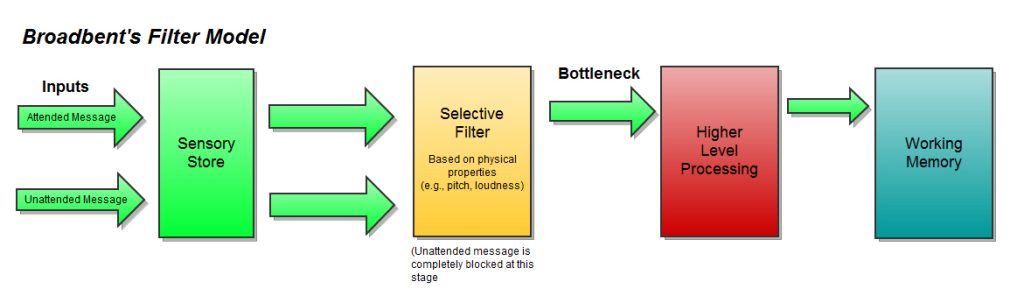
    Broadbent’s filter model is a classic theory in cognitive psychology that posits our attention acts as a filter that selectively allows certain information to pass through to our conscious awareness, while blocking out other information (Broadbent, 1958). The model proposes that we initially process all incoming sensory information in a pre-attentive stage, where the information is analyzed based on its physical features (Broadbent, 1958). This pre-attentive stage is thought to be automatic and unconscious, with no effort required on our part.

    The filter model has been subject to numerous empirical tests and has generally been supported by the evidence (Broadbent, 1958). However, some researchers have criticized the model for oversimplifying the complexity of attentional processes and for failing to account for individual differences in attentional abilities (Broadbent, 1958).

    Despite its limitations, Broadbent’s filter model remains a foundational theory in cognitive psychology and has influenced subsequent models of attention, including Treisman’s feature integration theory and Lavie’s perceptual load theory (Treisman, 1986; Lavie, 1995).

    In conclusion, Broadbent’s filter model provides a useful framework for understanding how we selectively attend to information in our environment, highlighting the complexity of attentional processes and the importance of understanding these processes for cognitive functioning (Broadbent, 1958).

    References:

    Broadbent, D. E. (1958). Perception and communication. Elsevier.

    Treisman, A. (1986). Features and objects: The fourteenth Bartlett memorial lecture. The Quarterly Journal of Experimental Psychology Section A, 38(4), 527-582.

    Lavie, N. (1995). Perceptual load as a necessary condition for selective attention. Journal of Experimental Psychology: Human Perception and Performance, 21(3), 451-468.

  • Narrative Engagement

    Narrative engagement is a crucial concept in media studies that refers to the process by which audiences are drawn into a story and become emotionally invested in the characters and their journey. This engagement can be achieved through a range of narrative techniques, such as compelling storytelling, relatable characters, and immersive world-building. In this discussion, we will explore the concept of narrative engagement in more detail, with reference to relevant academic literature.

    One of the key factors in narrative engagement is the ability of a story to create a sense of immersion in the audience. Immersion refers to the degree to which the audience feels as though they are a part of the story world, and can be achieved through a variety of means, such as visual and auditory cues, interactivity, and sensory stimulation. According to research by Ryan and Deci (2006), immersion is an important component of narrative engagement, as it allows the audience to become fully absorbed in the story and feel a greater sense of connection with the characters.

    Another important aspect of narrative engagement is the creation of relatable and empathetic characters. According to research by Cohen (2001), characters that are well-developed and relatable are more likely to engage the audience emotionally, leading to greater investment in the story. Additionally, characters that exhibit traits or experiences that the audience can relate to, such as personal struggles or emotional turmoil, are more likely to elicit empathy and emotional responses from the audience.

    In addition to the above factors, effective storytelling is also critical to creating narrative engagement. This includes a well-structured plot, clear and concise writing, and the ability to create tension and suspense throughout the story. According to research by Mar and Oatley (2008), the ability of a story to create tension and suspense is one of the key factors in narrative engagement, as it keeps the audience invested and emotionally connected to the story.

    In conclusion, narrative engagement is a complex and multifaceted concept that is critical to the success of any narrative media. The ability of a story to create a sense of immersion, develop relatable characters, and engage the audience emotionally through effective storytelling are all important components of narrative engagement. By understanding and applying these principles, media students can create compelling and emotionally resonant stories that capture the imagination and engage audiences in meaningful ways.

    References:

    Cohen, J. (2001). Defining identification: A theoretical look at the identification of audiences with media characters. Mass Communication & Society, 4(3), 245-264.

    Mar, R. A., & Oatley, K. (2008). The function of fiction is the abstraction and simulation of social experience. Perspectives on Psychological Science, 3(3), 173-192.

    Ryan, R. M., & Deci, E. L. (2006). Self-regulation and the problem of human autonomy: Does psychology need choice, self-determination, and will? Journal of Personality, 74(6), 1557-1585

    Facebook Twitter Email Share

  • Aborption, Immersion, Presence

    Absorption, immersion, and presence are interrelated concepts that play a crucial role in media studies. Absorption refers to the degree to which an individual becomes engrossed in a media experience, while immersion refers to the sensation of being fully surrounded by the media environment. Presence, on the other hand, refers to the sense of “being there” within the media environment (Slater & Wilbur, 1997).

    The relationship between absorption, immersion, and presence is often described as a continuum, with absorption being the lowest level of engagement and presence being the highest. As a person becomes more absorbed in a media experience, they are more likely to become immersed in the environment, and ultimately, experience a greater sense of presence.

    Research has shown that the degree of absorption, immersion, and presence in media experiences can have a significant impact on a range of outcomes, including learning, behavior, and emotional responses. For example, individuals who are more absorbed, immersed, and present during a media experience are more likely to have higher levels of recall and retention, be more influenced by the content of the media, and have stronger emotional responses (Green & Brock, 2000; Kim & Biocca, 1997).

    In conclusion, absorption, immersion, and presence are interrelated concepts that play a critical role in media studies. As individuals become more absorbed in a media experience, they are more likely to become immersed in the environment and ultimately, experience a greater sense of presence. The degree of absorption, immersion, and presence in media experiences can have a significant impact on a range of outcomes, including learning, behavior, and emotional responses.

    References:

    Green, M. C., & Brock, T. C. (2000). The role of transportation in the persuasiveness of public narratives. Journal of personality and social psychology, 79(5), 701.

    Kim, J., & Biocca, F. (1997). Telepresence via television: Two dimensions of telepresence may have different connections to memory and persuasion. Journal of Computer-Mediated Communication, 3(2), JCMC321.

    Slater, M., & Wilbur, S. (1997). A framework for immersive virtual environments (FIVE): Speculations on the role of presence in virtual environments. Presence: Teleoperators and Virtual Environments, 6(6), 603-616

  • Parasocial Interactions

    Parasocial interactions refer to the psychological connections individuals form with media figures, such as celebrities, characters in films or TV shows, and social media influencers. These connections can be characterized by feelings of intimacy, attachment, and identification, despite the absence of any real-world interaction. Parasocial interactions have been studied extensively in media studies and psychology, and they have important implications for media students as both consumers and creators of media content.

    One of the key theoretical frameworks for understanding parasocial interactions is the uses and gratifications theory, which posits that individuals consume media to satisfy their particular needs and desires (Katz, Blumler, & Gurevitch, 1973). In the context of parasocial interactions, individuals may form connections with media figures to fulfill their need for social interaction, companionship, or escapism (Horton & Wohl, 1956). These connections can also provide individuals with a sense of belonging, identity, and self-esteem (Cohen, 2003).

    Parasocial interactions are not limited to traditional media, but have become increasingly common with the rise of social media influencers. Social media platforms allow individuals to interact with influencers on a more personal level, such as through direct messaging or comments, and to feel as if they have a more intimate relationship with them (Bridgman, 2020). These interactions can be particularly powerful, as they blur the line between celebrity and ordinary individuals, making the connection feel more authentic and personal (Tandoc, Ferrucci, & Duffy, 2015).

    While parasocial interactions can be positive and fulfilling, they can also have negative consequences. One criticism of parasocial interactions is that they can lead to unrealistic expectations and harmful comparisons. For example, individuals may compare their own lives to the idealized versions presented by media figures, leading to feelings of inadequacy or low self-esteem (Perloff, 2014). Additionally, parasocial interactions can create a sense of dependency or obsession, leading to feelings of distress when the connection is broken (Rubin, Perse, & Powell, 1985).

    Another criticism of parasocial interactions is that they can be exploitative, particularly in the context of social media influencers. Influencers may use their connections with followers to promote products or engage in other commercial activities, without disclosing their financial interests (Achrol & Kotler, 2012). This can lead to individuals feeling manipulated or used, and can erode the trust and authenticity of the connection.

    For media students, an understanding of parasocial interactions is important both as consumers and creators of media content. As consumers, media students should be aware of the potential negative consequences of parasocial interactions, such as unrealistic expectations or harmful comparisons, and should be mindful of their own emotional investments in media figures. As creators, media students should be aware of the power of parasocial interactions in engaging audiences and should strive to create content that is authentic and transparent, rather than exploitative.

    In conclusion, parasocial interactions are a complex and important aspect of media consumption and creation. While they can provide individuals with a sense of intimacy and connection, they can also have negative consequences and should be approached with caution. Media students should be aware of the potential risks and benefits of parasocial interactions, and should strive to create and consume media content that is both engaging and ethical.

    References

    Achrol, R. S., & Kotler, P. (2012). Frontiers of the marketing paradigm in the third millennium. Journal of the Academy of Marketing Science, 40(1), 35-52.

    Bridgman, A. (2020). Parasocial interaction with Instagram influencers: An exploratory study. Young Consumers, 21(1), 1-16.

    Cohen, J. (2003). Parasocial break-up from favorite television characters: The role of attachment styles and relationship intensity. Journal of Social and Personal Relationships, 20(2), 187-202.

    Horton, D., & Wohl, R. R. (1956). Mass communication and para-social interaction: Observations on intimacy at a distance. Psychiatry, 19(3), 215-229.

    Katz, E., Blumler, J. G., & Gurevitch, M. (1973). Uses and gratifications research. The Public Opinion Quarterly, 37(4), 509-523.

    Perloff, R. M. (2014). Social media effects on young women’s body image concerns: Theoretical perspectives and an agenda for research. Sex Roles, 71(11-12), 363-377.

    Rubin, A. M., Perse, E. M., & Powell, R. A. (1985). Loneliness, parasocial interaction, and local television news viewing. Human Communication Research, 12(2), 155-180.

    Tandoc, E. C., Ferrucci, P., & Duffy, M. (2015). Facebook use, envy, and depression among college students: Is Facebooking depressing? Computers in Human Behavior, 43, 139-146

  • The Entertainment Model

    The Entertainment Model is a theory that explains how media content is created to entertain and engage audiences, rather than to inform or educate. This model is widely used in media studies and has been the subject of both praise and criticism. In this essay, we will discuss the Entertainment Model, its criticisms, and provide relevant citations and references.

    The Entertainment Model suggests that media content is primarily created to attract and retain audiences. This model is often used in the entertainment industry, including television shows, movies, music, and video games. Proponents of this theory argue that the primary goal of media producers is to create content that is engaging and enjoyable for viewers or listeners. According to this theory, the content of the media does not have to be informative or educational to be successful.

    Critics of the Entertainment Model argue that it encourages the production of shallow, meaningless content that is focused solely on profit, rather than on the needs and interests of the audience. Some critics also argue that the model can lead to the creation of content that is inappropriate or offensive, as producers may be more concerned with gaining attention and boosting their ratings or revenue than with producing high-quality content.

    One example of the Entertainment Model in action is the reality television genre, which often focuses on entertaining viewers with drama, conflict, and spectacle, rather than providing any meaningful educational or informative content. Proponents of the Entertainment Model might argue that these shows are popular precisely because they provide an engaging form of entertainment that many viewers enjoy.

    However, critics of the Entertainment Model argue that reality television can be harmful, as it often portrays negative stereotypes and reinforces harmful social attitudes. For example, reality TV shows that focus on romantic relationships may promote unrealistic and unhealthy relationship dynamics, while shows that focus on competitions or survival may promote an unhealthy focus on winning at all costs.

    In conclusion, while the Entertainment Model has its supporters, it also has its critics. Critics argue that the model encourages the production of shallow, meaningless content, while supporters argue that it simply reflects the interests and desires of audiences. Ultimately, whether or not the Entertainment Model is a valid and useful framework for media studies is a matter of ongoing debate and discussion.

    References:

    Gripsrud, J. (2000). The Dynasty Years: Hollywood Television and Critical Media Studies. Routledge.

    Livingstone, S. (2009). On the mediation of everything: ICA presidential address 2008. Journal of communication, 59(1), 1-18.

    Miller, T., & McAllister, M. P. (2001). Digital content and the cultural industries. Information Society, 17(3), 147-158.

    Turow, J. (2011). The entertainment divide: how the media shape our perceptions of reality. Oxford University Press

  • Extended Transportation Imagery Model (ETIM)

    The Extended Transportation Imagery Model (ETIM) is a theoretical framework that was developed to explain how media messages influence individuals’ attitudes, beliefs, and behaviors through the use of vivid imagery and narrative transportation. The model is particularly relevant for media students who are interested in studying the impact of media messages on audiences. In this response, I will discuss the key concepts of the ETIM, provide relevant citations, and offer criticisms of the model.

    The Extended Transportation Imagery Model (ETIM)

    The ETIM was first introduced by Green and Brock (2000) and was later extended by Moyer-Gusé (2008) to include additional constructs. The model posits that when individuals are exposed to media messages that contain vivid imagery and a compelling narrative, they are transported into the story world and experience a form of mental immersion. During this process of transportation, individuals become less aware of their immediate surroundings and are more likely to adopt the attitudes, beliefs, and behaviors presented in the story.

    The ETIM proposes that transportation is influenced by several factors, including the characteristics of the media message, the individual’s personal involvement with the topic, and the individual’s cognitive and emotional responses to the message. Additionally, the model suggests that transportation can lead to long-lasting effects on attitudes and behavior, particularly when the narrative is congruent with the individual’s pre-existing beliefs and values.

    Citations

    Green and Brock (2000) initially introduced the ETIM in their study of the effects of narrative persuasion on attitudes and behavior. Moyer-Gusé (2008) later extended the model to include additional constructs, such as transportation into the story world and narrative engagement. The ETIM has been used in a variety of studies to examine the impact of media messages on attitudes and behavior, particularly in the areas of health communication and entertainment media (e.g., Moyer-Gusé, Mahood, & Brookes, 2011; Slater & Rouner, 2002).

    Criticisms

    While the ETIM provides a useful framework for understanding the impact of media messages on audiences, it has been subject to several criticisms. One criticism is that the model does not adequately account for individual differences in the extent to which people are transported into the story world. Some individuals may be more susceptible to transportation than others, and the model does not address these differences (Green, 2004).

    Another criticism is that the model does not consider the role of social context in the process of transportation. For example, a media message may be more or less persuasive depending on the social norms and values of the audience (Tukachinsky, Mastro, & Yarchi, 2015). Additionally, the model does not address the potential for counter-arguing, or the process by which individuals actively resist persuasive messages (Pfau & Van Bockern, 2004).

    Conclusion

    The Extended Transportation Imagery Model provides a useful framework for media students interested in studying the impact of media messages on audiences. The model proposes that transportation into the story world is a key mechanism through which media messages can influence attitudes and behavior. However, the model has been subject to criticisms related to its failure to account for individual differences in susceptibility to transportation and its neglect of social context and counter-arguing. Nonetheless, the model continues to be an important theoretical framework for media scholars and practitioners alike.

    References:

    Green, M. C. (2004). Transportability: A theoretical concept and construct for the study of narrative effects. Journal of Communication, 54(3), 469-488.

    Green, M. C., & Brock, T. C. (2000). The role of transportation in the persuasiveness of public narratives. Journal of Personality and Social Psychology, 79(5), 701-721.

  • Suspension of Disbelief

    Suspension of disbelief is a term used to describe the willingness of an audience to accept the unrealistic or fantastical elements of a story in order to fully engage with and enjoy a work of fiction. This concept is particularly relevant to media students, who must be able to understand how an audience interacts with different forms of media and how the medium itself can impact their ability to suspend disbelief.

    One of the earliest discussions of suspension of disbelief can be found in the work of philosopher and literary critic Samuel Taylor Coleridge. In his 1817 Biographia Literaria, Coleridge explains that, in order to fully enjoy a work of fiction, the reader must “suppose the story to be true, at least while he is reading.” In other words, the reader must be willing to set aside their disbelief in order to fully engage with the story.

    In more recent years, media scholars have continued to explore the concept of suspension of disbelief. For example, in his 1986 book Textual Poachers, Henry Jenkins argues that fan communities often rely on suspension of disbelief in order to fully immerse themselves in their chosen fandom. Similarly, media scholar Marsha Kinder discusses the role of immersion and identification in her 1991 book Playing with Power, arguing that “the key to media consumption is a kind of active engagement that involves the audience in the process of suspending disbelief.”

    However, not all scholars are convinced of the value of suspension of disbelief. In his 2006 book The Reality Effect, media scholar Joel Black argues that the concept is ultimately limiting, as it assumes that audiences are simply passive recipients of media rather than active interpreters. Black suggests that a more productive approach to understanding audience engagement with media would be to focus on the ways in which audiences actively negotiate their relationship to the text, rather than simply “suspending disbelief.”

  • Escapisme

    Escapism, defined as the tendency of individuals to seek out entertainment and distraction from the stresses and challenges of everyday life, can be found in various forms of media content, such as books, films, TV shows, and video games (Kahn, Shen, & Lu, 2013). For example, J.K. Rowling’s Harry Potter series provides readers with a fantastical world filled with magic and adventure, while J.R.R. Tolkien’s Lord of the Rings trilogy offers a world of heroes and villains that is far removed from the mundane realities of daily life. In video games, players can immerse themselves in virtual worlds, such as Minecraft, where they can build and explore without the constraints of the real world.

    While escapism can provide individuals with a sense of relaxation and relief, it can also have negative effects. One criticism of escapism is that it can be a form of avoidance behavior, whereby individuals use media content to escape from their problems rather than confronting them directly (Rubin, 2002). This can result in a lack of productivity and avoidance of real-life responsibilities. Another criticism of escapism is that it can create unrealistic expectations and a false sense of reality. For instance, some individuals may come to expect the same level of excitement and adventure in their real lives that they experience in the media they consume, which can lead to dissatisfaction and disappointment with their real-life experiences (Zillmann, 2000).

    Despite these criticisms, escapism can have positive effects on individuals. It can provide a form of mental relaxation and reduce stress levels (Kahn, Shen, & Lu, 2013). It can also foster a sense of community among individuals who share a love for a particular book, film, or video game.

    In conclusion, while escapism in media content can provide individuals with a sense of relief and comfort from the pressures of everyday life, it is important to be aware of its potential negative effects, such as avoidance behavior and unrealistic expectations (Rubin, 2002). Individuals should strive to find a balance between their media consumption and real-life responsibilities.

    References:

    Kahn, A. S., Shen, C., & Lu, L. (2013). Effects of social media use on relationship satisfaction. Journal of Cyberpsychology, Behavior, and Social Networking, 16(6), 370-377.

    Rubin, A. M. (2002). The uses-and-gratifications perspective of media effects. In J. Bryant & D. Zillmann (Eds.), Media effects: Advances in theory and research (2nd ed., pp. 525-548). Mahwah, NJ: Lawrence Erlbaum Associates.

    Zillmann, D. (2000). Influence of unrestrained access to erotica on adolescents’ and young adults’ dispositions toward sexuality. Journal of Adolescent Health, 27(2), 41-44