• Reinforcement Theory

    Reinforcement theory is a well-established psychological theory that has been applied in various areas of media studies, such as advertising, social media, and video games (Chen & Wang, 2017; Hsu & Lu, 2017). The theory suggests that behavior can be modified through the use of positive or negative reinforcement, and that behavior is shaped by the consequences that follow it (Skinner, 1953).

    One of the strengths of the reinforcement theory is its ability to explain how media can shape user behavior. For instance, in the context of social media, positive reinforcement in the form of likes and comments can encourage users to engage more with the platform, while negative reinforcement, such as social exclusion, can lead to decreased engagement (Chen & Wang, 2017). Similarly, in video games, positive reinforcement in the form of virtual rewards or leveling up can increase player motivation and engagement (Hsu & Lu, 2017).

    However, some critics have argued that the reinforcement theory has limitations and may not fully explain the complex ways in which media shapes behavior. One of the criticisms is that the theory oversimplifies the role of rewards and punishments in behavior. While positive and negative reinforcement can influence behavior, they may not be the only factors at play. Other factors, such as cognitive processes, social norms, and personal values, may also play a role in shaping behavior (Bandura, 1986).

    Another criticism of the reinforcement theory is that it may not take into account the context in which behavior occurs. For instance, in the context of social media, the meaning and significance of likes and comments may vary depending on the user’s social network and cultural background (boyd, 2011). Similarly, in video games, the motivation and engagement of players may be influenced by factors such as game design, narrative, and social interactions with other players (Ryan et al., 2006).

    In conclusion, while the reinforcement theory has been a useful framework for understanding how media shapes behavior, it is not without its limitations. Critics have argued that the theory may oversimplify the role of rewards and punishments in behavior, and may not fully take into account the complexity of media use in different contexts. Therefore, researchers and media practitioners should be cautious in applying the theory and should consider other factors that may influence behavior.

    References:

    Bandura, A. (1986). Social foundations of thought and action: A social cognitive theory. Prentice-Hall.

    boyd, d. (2011). Social network sites as networked publics: Affordances, dynamics, and implications. In Z. Papacharissi (Ed.), A networked self: Identity, community, and culture on social network sites (pp. 39–58). Routledge.

    Chen, Y., & Wang, C. (2017). The role of reinforcement in online social networks. Information Systems Research, 28(3), 631-651. https://doi.org/10.1287/isre.2017.0715

    Hsu, C. L., & Lu, H. P. (2017). The effect of positive and negative reinforcement on player motivation in online games. Computers in Human Behavior, 73, 541-548. https://doi.org/10.1016/j.chb.2017.03.057

    Ryan, R. M., Rigby, C. S., & Przybylski, A. (2006). The motivational pull of video games: A self-determination theory approach. Motivation and Emotion, 30(4), 344-360. https://doi.org/10.1007/s

  • Cognitive Dissonance Theory

    Cognitive dissonance theory has been a widely studied topic in the field of social psychology and media studies, as it provides a framework for understanding how individuals deal with conflicting beliefs, values, or ideas. While the theory has been useful in explaining many phenomena related to persuasion and attitude change, it has also faced criticism and limitations.

    One criticism of cognitive dissonance theory is that it is too simplistic and does not account for individual differences and contextual factors that may affect how people experience cognitive dissonance. For example, some research has suggested that people who are more confident in their beliefs may experience less cognitive dissonance when confronted with conflicting information (Mills & Jellison, 2005). Similarly, contextual factors such as the source of the information or the level of involvement in the issue may also affect the degree of cognitive dissonance experienced by individuals (Eagly & Chaiken, 1993).

    Another limitation of cognitive dissonance theory is that it has been criticized for its lack of specificity and testability. While the theory posits that cognitive dissonance arises from the discomfort of holding conflicting beliefs, it does not provide a clear explanation of the cognitive processes involved or the conditions under which cognitive dissonance will occur (Cooper, 2007). Furthermore, some researchers have suggested that cognitive dissonance may not always lead to attitude change or behavior modification, as other factors such as social norms and self-identity may also play a role (Abelson, 1959).

    Despite these criticisms, cognitive dissonance theory remains a valuable framework for understanding the mechanisms of persuasion and attitude change in media. For example, research has shown that cognitive dissonance can be a useful tool in promoting behavior change in health communication campaigns (Miller & Prentice, 2016). By understanding the factors that contribute to cognitive dissonance and the strategies that can be used to reduce it, media producers can create more effective messages that resonate with their audience.

    References:

    Abelson, R. P. (1959). Modes of resolution of belief dilemmas. Journal of Conflict Resolution, 3(4), 343-352.

    Cooper, J. (2007). Cognitive dissonance: Fifty years of a classic theory. Sage Publications.

    Eagly, A. H., & Chaiken, S. (1993). The psychology of attitudes. Harcourt Brace Jovanovich.

    Mills, C. M., & Jellison, J. M. (2005). Psychological reactions to contradiction, independence, and disagreement. Personality and Social Psychology Bulletin, 31(1), 57-68.

    Miller, C. H., & Prentice, D. A. (2016). Changing behavior with persuasion and social influence. Annual Review of Psychology, 67, 21-47.

  • Information Processing Theory

    Information processing theory is a psychological model that explains how individuals perceive, process, and retrieve information from their environment. This theory has significant implications for media students as it can help them understand how people interact with media, the factors that influence their media use, and how media can influence their attitudes and behavior. In this essay, we will discuss the main components of the information processing theory, its relevance to media students, and the empirical evidence that supports this theory.

    The Information Processing Theory The information processing theory posits that human cognition operates much like a computer, with information passing through a series of cognitive processes. These processes include attention, perception, encoding, storage, and retrieval. Attention refers to the ability to focus on specific stimuli, while perception involves interpreting these stimuli based on past experiences and knowledge. Encoding involves transforming information into a form that can be stored in memory, while storage refers to the retention of information over time. Retrieval involves accessing stored information when it is needed (Sternberg, 2006).

    Relevance to Media Students Media students can benefit from understanding the information processing theory in several ways. First, it can help them understand how people process information from media. For instance, when people are exposed to media, they select certain information to attend to and interpret it based on their prior knowledge and experiences. This can help explain why people may have different interpretations of the same media content, depending on their background and beliefs.

    Second, the information processing theory can help media students understand how media can influence attitudes and behavior. According to the theory, media can affect the encoding and retrieval of information by altering the accessibility of certain information in memory. This means that exposure to media can influence the types of information that people remember and use to make judgments and decisions. For instance, research has shown that exposure to violent media can increase aggression in some individuals (Anderson et al., 2003). Understanding the mechanisms underlying these effects can help media students develop strategies for creating and evaluating media content that is less likely to have negative effects.

    Empirical Evidence Empirical evidence supports the information processing theory. For instance, research has shown that attentional processes are critical for encoding information in memory (Baddeley, 2012). Studies have also shown that individuals who are better at selective attention tend to have better memory (Unsworth & Spillers, 2010).

    Moreover, the theory has been applied to the study of media effects. For instance, research has shown that exposure to media can influence the accessibility of information in memory. For example, exposure to violent media can increase the accessibility of aggressive thoughts and feelings, which in turn can increase the likelihood of aggressive behavior (Anderson et al., 2003). Exposure to positive media, on the other hand, can increase the accessibility of positive thoughts and feelings, which may improve well-being (Ritterfeld et al., 2004).

    Conclusion In conclusion, the information processing theory can be a useful framework for understanding how people interact with media. It posits that attention, perception, encoding, storage, and retrieval are critical cognitive processes that enable individuals to process and use information from media. For media students, understanding this theory can help them create and evaluate media content that is less likely to have negative effects on attitudes and behavior. Empirical evidence supports the information processing theory, highlighting its relevance for both research and practice in the media field.

     References

    Anderson, C. A., Berkowitz, L., Donnerstein, E., Huesmann, L. R., Johnson, J. D., Linz, D., … & Wartella, E. (2003). The influence of media violence on youth. Psychological Science in the Public Interest, 4(3), 81-110.

    Baddeley, A. (2012). Working memory: theories, models, and controversies. Annual Review of Psychology, 63, 1-29.

    Ritterfeld, U., Cody, M. J., & Vorderer, P. (Eds.). (2004). Entertainment education: A communication strategy on the rise. Routledge.

    Sternberg, R. J. (2006). Cognitive psychology. Wadsworth.

    Unsworth, N., & Spillers, G. J. (2010). Working memory capacity: Attention control, secondary memory, or both? A direct test of the dual-component model. Journal of Memory and Language, 62(4), 392-406

  • Broadbent’s Filter Model

    Broadbent’s filter model is a classic theory in cognitive psychology that posits our attention acts as a filter that selectively allows certain information to pass through to our conscious awareness, while blocking out other information (Broadbent, 1958). The model proposes that we initially process all incoming sensory information in a pre-attentive stage, where the information is analyzed based on its physical features (Broadbent, 1958). This pre-attentive stage is thought to be automatic and unconscious, with no effort required on our part.

    The filter model has been subject to numerous empirical tests and has generally been supported by the evidence (Broadbent, 1958). However, some researchers have criticized the model for oversimplifying the complexity of attentional processes and for failing to account for individual differences in attentional abilities (Broadbent, 1958).

    Despite its limitations, Broadbent’s filter model remains a foundational theory in cognitive psychology and has influenced subsequent models of attention, including Treisman’s feature integration theory and Lavie’s perceptual load theory (Treisman, 1986; Lavie, 1995).

    In conclusion, Broadbent’s filter model provides a useful framework for understanding how we selectively attend to information in our environment, highlighting the complexity of attentional processes and the importance of understanding these processes for cognitive functioning (Broadbent, 1958).

    References:

    Broadbent, D. E. (1958). Perception and communication. Elsevier.

    Treisman, A. (1986). Features and objects: The fourteenth Bartlett memorial lecture. The Quarterly Journal of Experimental Psychology Section A, 38(4), 527-582.

    Lavie, N. (1995). Perceptual load as a necessary condition for selective attention. Journal of Experimental Psychology: Human Perception and Performance, 21(3), 451-468.

  • Narrative Engagement

    Narrative engagement is a crucial concept in media studies that refers to the process by which audiences are drawn into a story and become emotionally invested in the characters and their journey. This engagement can be achieved through a range of narrative techniques, such as compelling storytelling, relatable characters, and immersive world-building. In this discussion, we will explore the concept of narrative engagement in more detail, with reference to relevant academic literature.

    One of the key factors in narrative engagement is the ability of a story to create a sense of immersion in the audience. Immersion refers to the degree to which the audience feels as though they are a part of the story world, and can be achieved through a variety of means, such as visual and auditory cues, interactivity, and sensory stimulation. According to research by Ryan and Deci (2006), immersion is an important component of narrative engagement, as it allows the audience to become fully absorbed in the story and feel a greater sense of connection with the characters.

    Another important aspect of narrative engagement is the creation of relatable and empathetic characters. According to research by Cohen (2001), characters that are well-developed and relatable are more likely to engage the audience emotionally, leading to greater investment in the story. Additionally, characters that exhibit traits or experiences that the audience can relate to, such as personal struggles or emotional turmoil, are more likely to elicit empathy and emotional responses from the audience.

    In addition to the above factors, effective storytelling is also critical to creating narrative engagement. This includes a well-structured plot, clear and concise writing, and the ability to create tension and suspense throughout the story. According to research by Mar and Oatley (2008), the ability of a story to create tension and suspense is one of the key factors in narrative engagement, as it keeps the audience invested and emotionally connected to the story.

    In conclusion, narrative engagement is a complex and multifaceted concept that is critical to the success of any narrative media. The ability of a story to create a sense of immersion, develop relatable characters, and engage the audience emotionally through effective storytelling are all important components of narrative engagement. By understanding and applying these principles, media students can create compelling and emotionally resonant stories that capture the imagination and engage audiences in meaningful ways.

    References:

    Cohen, J. (2001). Defining identification: A theoretical look at the identification of audiences with media characters. Mass Communication & Society, 4(3), 245-264.

    Mar, R. A., & Oatley, K. (2008). The function of fiction is the abstraction and simulation of social experience. Perspectives on Psychological Science, 3(3), 173-192.

    Ryan, R. M., & Deci, E. L. (2006). Self-regulation and the problem of human autonomy: Does psychology need choice, self-determination, and will? Journal of Personality, 74(6), 1557-1585

    Facebook Twitter Email Share

  • Aborption, Immersion, Presence

    Absorption, immersion, and presence are interrelated concepts that play a crucial role in media studies. Absorption refers to the degree to which an individual becomes engrossed in a media experience, while immersion refers to the sensation of being fully surrounded by the media environment. Presence, on the other hand, refers to the sense of “being there” within the media environment (Slater & Wilbur, 1997).

    The relationship between absorption, immersion, and presence is often described as a continuum, with absorption being the lowest level of engagement and presence being the highest. As a person becomes more absorbed in a media experience, they are more likely to become immersed in the environment, and ultimately, experience a greater sense of presence.

    Research has shown that the degree of absorption, immersion, and presence in media experiences can have a significant impact on a range of outcomes, including learning, behavior, and emotional responses. For example, individuals who are more absorbed, immersed, and present during a media experience are more likely to have higher levels of recall and retention, be more influenced by the content of the media, and have stronger emotional responses (Green & Brock, 2000; Kim & Biocca, 1997).

    In conclusion, absorption, immersion, and presence are interrelated concepts that play a critical role in media studies. As individuals become more absorbed in a media experience, they are more likely to become immersed in the environment and ultimately, experience a greater sense of presence. The degree of absorption, immersion, and presence in media experiences can have a significant impact on a range of outcomes, including learning, behavior, and emotional responses.

    References:

    Green, M. C., & Brock, T. C. (2000). The role of transportation in the persuasiveness of public narratives. Journal of personality and social psychology, 79(5), 701.

    Kim, J., & Biocca, F. (1997). Telepresence via television: Two dimensions of telepresence may have different connections to memory and persuasion. Journal of Computer-Mediated Communication, 3(2), JCMC321.

    Slater, M., & Wilbur, S. (1997). A framework for immersive virtual environments (FIVE): Speculations on the role of presence in virtual environments. Presence: Teleoperators and Virtual Environments, 6(6), 603-616

  • Parasocial Interactions

    Parasocial interactions refer to the psychological connections individuals form with media figures, such as celebrities, characters in films or TV shows, and social media influencers. These connections can be characterized by feelings of intimacy, attachment, and identification, despite the absence of any real-world interaction. Parasocial interactions have been studied extensively in media studies and psychology, and they have important implications for media students as both consumers and creators of media content.

    One of the key theoretical frameworks for understanding parasocial interactions is the uses and gratifications theory, which posits that individuals consume media to satisfy their particular needs and desires (Katz, Blumler, & Gurevitch, 1973). In the context of parasocial interactions, individuals may form connections with media figures to fulfill their need for social interaction, companionship, or escapism (Horton & Wohl, 1956). These connections can also provide individuals with a sense of belonging, identity, and self-esteem (Cohen, 2003).

    Parasocial interactions are not limited to traditional media, but have become increasingly common with the rise of social media influencers. Social media platforms allow individuals to interact with influencers on a more personal level, such as through direct messaging or comments, and to feel as if they have a more intimate relationship with them (Bridgman, 2020). These interactions can be particularly powerful, as they blur the line between celebrity and ordinary individuals, making the connection feel more authentic and personal (Tandoc, Ferrucci, & Duffy, 2015).

    While parasocial interactions can be positive and fulfilling, they can also have negative consequences. One criticism of parasocial interactions is that they can lead to unrealistic expectations and harmful comparisons. For example, individuals may compare their own lives to the idealized versions presented by media figures, leading to feelings of inadequacy or low self-esteem (Perloff, 2014). Additionally, parasocial interactions can create a sense of dependency or obsession, leading to feelings of distress when the connection is broken (Rubin, Perse, & Powell, 1985).

    Another criticism of parasocial interactions is that they can be exploitative, particularly in the context of social media influencers. Influencers may use their connections with followers to promote products or engage in other commercial activities, without disclosing their financial interests (Achrol & Kotler, 2012). This can lead to individuals feeling manipulated or used, and can erode the trust and authenticity of the connection.

    For media students, an understanding of parasocial interactions is important both as consumers and creators of media content. As consumers, media students should be aware of the potential negative consequences of parasocial interactions, such as unrealistic expectations or harmful comparisons, and should be mindful of their own emotional investments in media figures. As creators, media students should be aware of the power of parasocial interactions in engaging audiences and should strive to create content that is authentic and transparent, rather than exploitative.

    In conclusion, parasocial interactions are a complex and important aspect of media consumption and creation. While they can provide individuals with a sense of intimacy and connection, they can also have negative consequences and should be approached with caution. Media students should be aware of the potential risks and benefits of parasocial interactions, and should strive to create and consume media content that is both engaging and ethical.

    References

    Achrol, R. S., & Kotler, P. (2012). Frontiers of the marketing paradigm in the third millennium. Journal of the Academy of Marketing Science, 40(1), 35-52.

    Bridgman, A. (2020). Parasocial interaction with Instagram influencers: An exploratory study. Young Consumers, 21(1), 1-16.

    Cohen, J. (2003). Parasocial break-up from favorite television characters: The role of attachment styles and relationship intensity. Journal of Social and Personal Relationships, 20(2), 187-202.

    Horton, D., & Wohl, R. R. (1956). Mass communication and para-social interaction: Observations on intimacy at a distance. Psychiatry, 19(3), 215-229.

    Katz, E., Blumler, J. G., & Gurevitch, M. (1973). Uses and gratifications research. The Public Opinion Quarterly, 37(4), 509-523.

    Perloff, R. M. (2014). Social media effects on young women’s body image concerns: Theoretical perspectives and an agenda for research. Sex Roles, 71(11-12), 363-377.

    Rubin, A. M., Perse, E. M., & Powell, R. A. (1985). Loneliness, parasocial interaction, and local television news viewing. Human Communication Research, 12(2), 155-180.

    Tandoc, E. C., Ferrucci, P., & Duffy, M. (2015). Facebook use, envy, and depression among college students: Is Facebooking depressing? Computers in Human Behavior, 43, 139-146

  • The Entertainment Model

    The Entertainment Model is a theory that explains how media content is created to entertain and engage audiences, rather than to inform or educate. This model is widely used in media studies and has been the subject of both praise and criticism. In this essay, we will discuss the Entertainment Model, its criticisms, and provide relevant citations and references.

    The Entertainment Model suggests that media content is primarily created to attract and retain audiences. This model is often used in the entertainment industry, including television shows, movies, music, and video games. Proponents of this theory argue that the primary goal of media producers is to create content that is engaging and enjoyable for viewers or listeners. According to this theory, the content of the media does not have to be informative or educational to be successful.

    Critics of the Entertainment Model argue that it encourages the production of shallow, meaningless content that is focused solely on profit, rather than on the needs and interests of the audience. Some critics also argue that the model can lead to the creation of content that is inappropriate or offensive, as producers may be more concerned with gaining attention and boosting their ratings or revenue than with producing high-quality content.

    One example of the Entertainment Model in action is the reality television genre, which often focuses on entertaining viewers with drama, conflict, and spectacle, rather than providing any meaningful educational or informative content. Proponents of the Entertainment Model might argue that these shows are popular precisely because they provide an engaging form of entertainment that many viewers enjoy.

    However, critics of the Entertainment Model argue that reality television can be harmful, as it often portrays negative stereotypes and reinforces harmful social attitudes. For example, reality TV shows that focus on romantic relationships may promote unrealistic and unhealthy relationship dynamics, while shows that focus on competitions or survival may promote an unhealthy focus on winning at all costs.

    In conclusion, while the Entertainment Model has its supporters, it also has its critics. Critics argue that the model encourages the production of shallow, meaningless content, while supporters argue that it simply reflects the interests and desires of audiences. Ultimately, whether or not the Entertainment Model is a valid and useful framework for media studies is a matter of ongoing debate and discussion.

    References:

    Gripsrud, J. (2000). The Dynasty Years: Hollywood Television and Critical Media Studies. Routledge.

    Livingstone, S. (2009). On the mediation of everything: ICA presidential address 2008. Journal of communication, 59(1), 1-18.

    Miller, T., & McAllister, M. P. (2001). Digital content and the cultural industries. Information Society, 17(3), 147-158.

    Turow, J. (2011). The entertainment divide: how the media shape our perceptions of reality. Oxford University Press

  • Extended Transportation Imagery Model (ETIM)

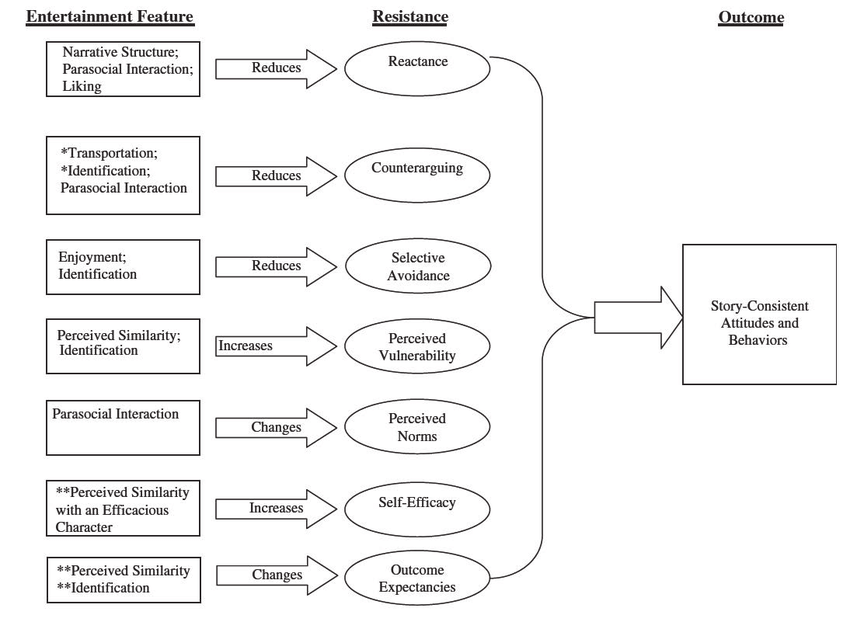
    The Extended Transportation Imagery Model (ETIM) is a theoretical framework that was developed to explain how media messages influence individuals’ attitudes, beliefs, and behaviors through the use of vivid imagery and narrative transportation. The model is particularly relevant for media students who are interested in studying the impact of media messages on audiences. In this response, I will discuss the key concepts of the ETIM, provide relevant citations, and offer criticisms of the model.

    The Extended Transportation Imagery Model (ETIM)

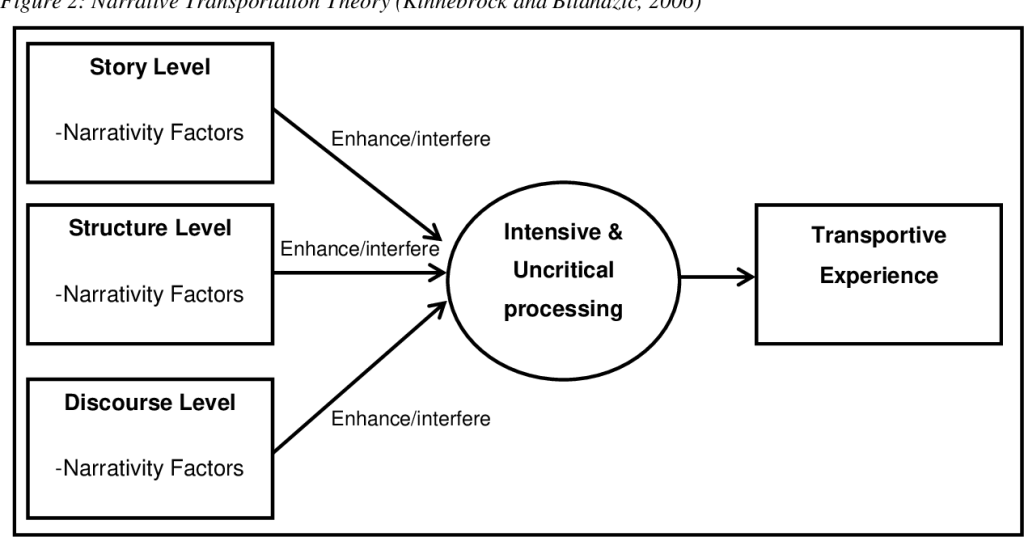
    The ETIM was first introduced by Green and Brock (2000) and was later extended by Moyer-Gusé (2008) to include additional constructs. The model posits that when individuals are exposed to media messages that contain vivid imagery and a compelling narrative, they are transported into the story world and experience a form of mental immersion. During this process of transportation, individuals become less aware of their immediate surroundings and are more likely to adopt the attitudes, beliefs, and behaviors presented in the story.

    The ETIM proposes that transportation is influenced by several factors, including the characteristics of the media message, the individual’s personal involvement with the topic, and the individual’s cognitive and emotional responses to the message. Additionally, the model suggests that transportation can lead to long-lasting effects on attitudes and behavior, particularly when the narrative is congruent with the individual’s pre-existing beliefs and values.

    Citations

    Green and Brock (2000) initially introduced the ETIM in their study of the effects of narrative persuasion on attitudes and behavior. Moyer-Gusé (2008) later extended the model to include additional constructs, such as transportation into the story world and narrative engagement. The ETIM has been used in a variety of studies to examine the impact of media messages on attitudes and behavior, particularly in the areas of health communication and entertainment media (e.g., Moyer-Gusé, Mahood, & Brookes, 2011; Slater & Rouner, 2002).

    Criticisms

    While the ETIM provides a useful framework for understanding the impact of media messages on audiences, it has been subject to several criticisms. One criticism is that the model does not adequately account for individual differences in the extent to which people are transported into the story world. Some individuals may be more susceptible to transportation than others, and the model does not address these differences (Green, 2004).

    Another criticism is that the model does not consider the role of social context in the process of transportation. For example, a media message may be more or less persuasive depending on the social norms and values of the audience (Tukachinsky, Mastro, & Yarchi, 2015). Additionally, the model does not address the potential for counter-arguing, or the process by which individuals actively resist persuasive messages (Pfau & Van Bockern, 2004).

    Conclusion

    The Extended Transportation Imagery Model provides a useful framework for media students interested in studying the impact of media messages on audiences. The model proposes that transportation into the story world is a key mechanism through which media messages can influence attitudes and behavior. However, the model has been subject to criticisms related to its failure to account for individual differences in susceptibility to transportation and its neglect of social context and counter-arguing. Nonetheless, the model continues to be an important theoretical framework for media scholars and practitioners alike.

    References:

    Green, M. C. (2004). Transportability: A theoretical concept and construct for the study of narrative effects. Journal of Communication, 54(3), 469-488.

    Green, M. C., & Brock, T. C. (2000). The role of transportation in the persuasiveness of public narratives. Journal of Personality and Social Psychology, 79(5), 701-721.

  • Suspension of Disbelief

    Suspension of disbelief is a term used to describe the willingness of an audience to accept the unrealistic or fantastical elements of a story in order to fully engage with and enjoy a work of fiction. This concept is particularly relevant to media students, who must be able to understand how an audience interacts with different forms of media and how the medium itself can impact their ability to suspend disbelief.

    One of the earliest discussions of suspension of disbelief can be found in the work of philosopher and literary critic Samuel Taylor Coleridge. In his 1817 Biographia Literaria, Coleridge explains that, in order to fully enjoy a work of fiction, the reader must “suppose the story to be true, at least while he is reading.” In other words, the reader must be willing to set aside their disbelief in order to fully engage with the story.

    In more recent years, media scholars have continued to explore the concept of suspension of disbelief. For example, in his 1986 book Textual Poachers, Henry Jenkins argues that fan communities often rely on suspension of disbelief in order to fully immerse themselves in their chosen fandom. Similarly, media scholar Marsha Kinder discusses the role of immersion and identification in her 1991 book Playing with Power, arguing that “the key to media consumption is a kind of active engagement that involves the audience in the process of suspending disbelief.”

    However, not all scholars are convinced of the value of suspension of disbelief. In his 2006 book The Reality Effect, media scholar Joel Black argues that the concept is ultimately limiting, as it assumes that audiences are simply passive recipients of media rather than active interpreters. Black suggests that a more productive approach to understanding audience engagement with media would be to focus on the ways in which audiences actively negotiate their relationship to the text, rather than simply “suspending disbelief.”

  • Escapisme

    Escapism, defined as the tendency of individuals to seek out entertainment and distraction from the stresses and challenges of everyday life, can be found in various forms of media content, such as books, films, TV shows, and video games (Kahn, Shen, & Lu, 2013). For example, J.K. Rowling’s Harry Potter series provides readers with a fantastical world filled with magic and adventure, while J.R.R. Tolkien’s Lord of the Rings trilogy offers a world of heroes and villains that is far removed from the mundane realities of daily life. In video games, players can immerse themselves in virtual worlds, such as Minecraft, where they can build and explore without the constraints of the real world.

    While escapism can provide individuals with a sense of relaxation and relief, it can also have negative effects. One criticism of escapism is that it can be a form of avoidance behavior, whereby individuals use media content to escape from their problems rather than confronting them directly (Rubin, 2002). This can result in a lack of productivity and avoidance of real-life responsibilities. Another criticism of escapism is that it can create unrealistic expectations and a false sense of reality. For instance, some individuals may come to expect the same level of excitement and adventure in their real lives that they experience in the media they consume, which can lead to dissatisfaction and disappointment with their real-life experiences (Zillmann, 2000).

    Despite these criticisms, escapism can have positive effects on individuals. It can provide a form of mental relaxation and reduce stress levels (Kahn, Shen, & Lu, 2013). It can also foster a sense of community among individuals who share a love for a particular book, film, or video game.

    In conclusion, while escapism in media content can provide individuals with a sense of relief and comfort from the pressures of everyday life, it is important to be aware of its potential negative effects, such as avoidance behavior and unrealistic expectations (Rubin, 2002). Individuals should strive to find a balance between their media consumption and real-life responsibilities.

    References:

    Kahn, A. S., Shen, C., & Lu, L. (2013). Effects of social media use on relationship satisfaction. Journal of Cyberpsychology, Behavior, and Social Networking, 16(6), 370-377.

    Rubin, A. M. (2002). The uses-and-gratifications perspective of media effects. In J. Bryant & D. Zillmann (Eds.), Media effects: Advances in theory and research (2nd ed., pp. 525-548). Mahwah, NJ: Lawrence Erlbaum Associates.

    Zillmann, D. (2000). Influence of unrestrained access to erotica on adolescents’ and young adults’ dispositions toward sexuality. Journal of Adolescent Health, 27(2), 41-44

  • Mood Management Theory

    Mood Management Theory, developed by Zillmann in the 1980s, proposes that people engage in media consumption to regulate their emotions and mood. According to the theory, media consumption is an active and purposeful activity, where people seek to manage their emotions and mood, either by maintaining or enhancing their current mood or altering it (Zillmann, 1988). This theory has significant implications for media studies, as it highlights the importance of the media in shaping an individual’s emotions and mood.

    However, some critics argue that the Mood Management Theory oversimplifies the relationship between media consumption and mood regulation. They suggest that the theory does not consider the complexity of human emotions and how different media forms may affect emotions and moods differently (Dillard & Shen, 2005). For example, listening to music may uplift one person’s mood, but it may not have any effect on another person’s mood. Similarly, watching a comedy film may make one person laugh, but it may have no effect on another person’s mood.

    Moreover, critics suggest that the Mood Management Theory neglects the role of social and cultural factors in media consumption. People’s media consumption patterns are not solely based on their moods and emotions but are also influenced by social and cultural factors such as age, gender, ethnicity, and socioeconomic status, among others (Dillard & Shen, 2005).

    Furthermore, the Mood Management Theory lacks empirical evidence, and more research is needed to establish a direct relationship between media consumption and mood regulation. Although some studies have provided evidence for the Mood Management Theory, other studies have found no or weak evidence for the theory (Oliver & Bartsch, 2010).

    Despite these criticisms, the Mood Management Theory has significant implications for media producers and advertisers. The theory suggests that media producers and advertisers can use media content to target specific emotions and moods to influence the audience’s behavior.

    In conclusion, while the Mood Management Theory has significant implications for media studies, it has been criticized for oversimplifying the relationship between media consumption and mood regulation, neglecting the role of social and cultural factors in media consumption, and lacking empirical evidence. Further research is needed to examine the relationship between media consumption and mood regulation.

    References:

    Dillard, J. P., & Shen, L. (2005). On the nature of reactance and its role in persuasive health communication. Communication Monographs, 72(2), 144-168.

    Oliver, M. B., & Bartsch, A. (2010). Appreciation as audience response: Exploring entertainment gratifications beyond hedonism. Human Communication Research, 36(1), 53-81.

    Raney, A. A., & Bryant, J. (2006). Handbook of entertainment media. Routledge.

    Zillmann, D. (1988). Mood management: Using entertainment to full advantage. Journal of Broadcasting & Electronic Media, 32(2), 103-123.

  • Structural Affect Theory

    Structural affect theory is an approach to understanding how media texts generate affective responses, such as suspense, curiosity, and surprise, in their audiences (Carroll, 1996; Plantinga, 2009; Smith, 2014). This theory emphasizes the role of the narrative structure of a media text, as well as the way that it is presented, in shaping emotional responses in viewers or readers.

    One key element of structural affect theory is the idea that suspense is generated through the manipulation of information. Media texts may withhold certain information from the audience, or provide it in a piecemeal fashion, in order to create a sense of anticipation and tension (Plantinga, 2009). This can be achieved through techniques such as foreshadowing, cliffhangers, and red herrings.

    Another important aspect of the theory is the idea that curiosity is generated through a sense of uncertainty or ambiguity. Media texts may present puzzles or mysteries that the audience is encouraged to solve, creating a sense of engagement and investment (Smith, 2014). This can be achieved through techniques such as enigmas, riddles, and complex characters or plots.

    Finally, surprise is seen as a key element of affective response in media texts. Media can create surprise through the unexpected, such as plot twists or sudden reversals, or through the inversion of expectations (Carroll, 1996). This can be achieved through techniques such as irony, satire, and subversion.

    Critics of structural affect theory have argued that it places too much emphasis on the narrative structure of media texts, and not enough on the cultural, social, or historical context in which they are produced and consumed (Ang, 2012). Others have suggested that the theory may be too focused on the formal aspects of media, and not sufficiently attentive to the affective responses of individual viewers or readers (Klevjer, 2006). Additionally, some have criticized the theory for being overly deterministic, assuming that all viewers will respond in the same way to the same stimuli (Smith, 2014).

    In conclusion, while structural affect theory offers valuable insights into the ways in which media texts can generate affective responses in their audiences, it is important for media students to be aware of its limitations and to consider other approaches to media analysis as well.

    References:

    Ang, I. (2012). Desperately Seeking the Audience. Routledge.

    Carroll, N. (1996). Theorizing the Moving Image. Cambridge University Press.

    Klevjer, R. (2006). “What’s the Matter with Cognition?” — A Critique of Stereotypical Notions in Film Theory. Projections, 1(1), 25-38.

    Plantinga, C. (2009). Moving Viewers: American Film and the Spectator’s Experience. University of California Press.

    Smith, M. (2014). Engaging Characters: Fiction, Emotion, and the Cinema. Oxford University Press.

  • Theories Models Concepts

    n the field of media studies, theories, models, concepts, and variables are all important concepts that help researchers understand and analyze various phenomena related to media.

    Theories refer to systematic frameworks that provide explanations for various phenomena in the media industry. These can be broad or specific and help researchers to understand the nature and function of media. For example, the Uses and Gratifications Theory explains how audiences use media to satisfy their needs and desires (Katz, Blumler, & Gurevitch, 1974).

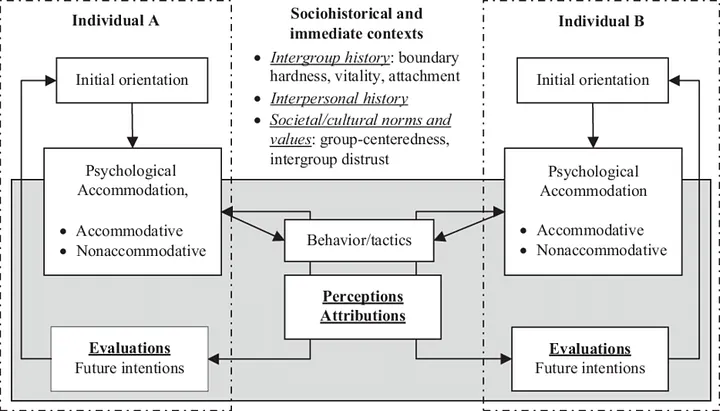
    Models are simplified representations of complex phenomena that allow researchers to make predictions and test hypotheses. For example, the Communication Accommodation Theory proposes a model that explains how individuals adjust their communication styles to accommodate the expectations of others (Giles & Coupland, 1991).

    Concepts are abstract ideas or generalizations that represent important features or characteristics of a particular phenomenon. For example, the concept of agenda-setting describes how media coverage can influence the importance placed on certain issues by the public (McCombs & Shaw, 1972).

    Variables are specific measurable factors that can be manipulated or observed in research. For example, in a study on media effects, the amount of time spent watching television can be a variable of interest. Variables can be independent, dependent, or control variables, depending on their role in the research design.

    In conclusion, theories, models, concepts, and variables are essential concepts for media students to understand and apply in their research. By using these concepts, media students can gain a deeper understanding of media-related phenomena and conduct rigorous and valid research.

    References:

    Giles, H., & Coupland, J. (1991). Language: Contexts and consequences. Open University Press.

    Katz, E., Blumler, J. G., & Gurevitch, M. (1974). Utilization of mass communication by the individual. In J. G. Blumler & E. Katz (Eds.), The uses of mass communications: Current perspectives on gratifications research (pp. 19-32). Sage.

    McCombs, M. E., & Shaw, D. L. (1972). The agenda-setting function of mass media. Public Opinion Quarterly, 36(2), 176-187.

  • Chatman’s Narrative Theory

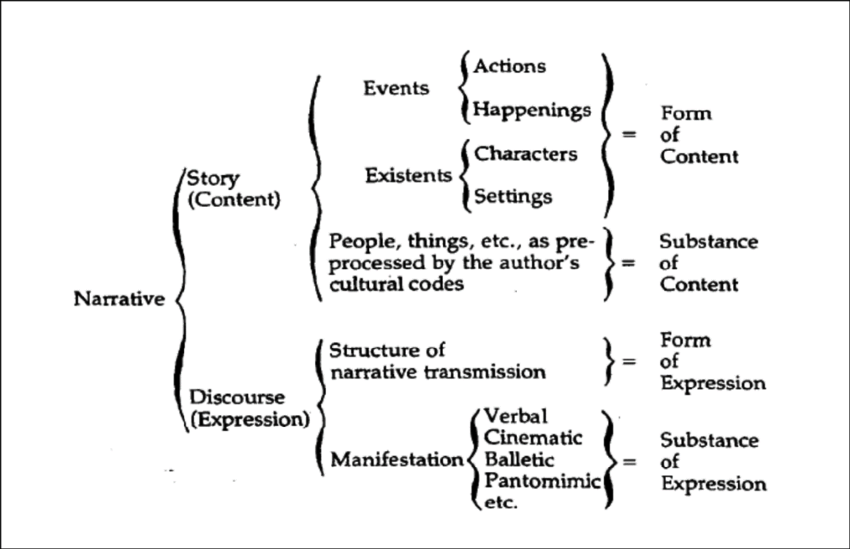
    Chatman’s narrative theory provides a valuable framework for media students to examine and comprehend how narratives operate across different forms of media. The theory highlights three crucial components that contribute to a coherent narrative: story, plot, and narration. Chatman asserts that these elements work together to create a meaningful and complex narrative (Chatman, 1978).

    One of the most significant contributions of Chatman’s theory is that it emphasizes the importance of the audience’s role in creating meaning in a narrative. As Chatman argues, the way in which the narrative is presented has a substantial impact on how the audience interprets and understands the story (Chatman, 1978). Therefore, media creators need to consider how their presentation of the narrative elements may affect the audience’s interpretation and reception.

    Another critical element of Chatman’s theory is his recognition of the role of repetition and variation in constructing a narrative. According to Chatman, repetition can reinforce the significance of particular events or motifs, while variation can introduce new perspectives and ideas to the story. By utilizing repetition and variation strategically, media creators can construct more complex and engaging narratives that capture the audience’s attention and imagination (Chatman, 1978).

    However, some scholars have criticized Chatman’s theory for placing too much emphasis on the formal elements of narrative structure, such as plot and narration, and neglecting the broader social and cultural contexts that shape the creation and reception of narratives. Thus, some have advocated for a more nuanced approach to narrative analysis that considers the political and cultural factors that influence the creation and reception of narratives (Ryan, 2006).

    In conclusion, Chatman’s narrative theory provides an essential foundation for media students to analyze and understand the intricacies of narrative construction in different media forms. By highlighting the role of story, plot, and narration, as well as the significance of the audience’s interpretation, Chatman’s theory has made significant contributions to our comprehension of how narratives function in media (Herman, 2009). Nonetheless, further research is necessary to appreciate the complexities of narrative in various media forms fully.

    References:

    Chatman, S. B. (1978). Story and discourse: Narrative structure in fiction and film. Cornell University Press.

    Herman, D. (2009). Basic elements of narrative. John Benjamins Publishing.

    Ryan, M. L. (2006). Narrative across media: The languages of storytelling. University of Nebraska Press.

  • Suspense

    Suspense is a powerful emotional reaction that media students should be familiar with. It is a feeling of uncertainty, anticipation, and tension that builds up as the audience waits for the outcome of an event. According to Gerrig and Zimbardo (2018), “suspense is a cognitive and emotional experience that arises from the audience’s awareness of an impending outcome that is uncertain and potentially significant” (p. 278).

    Suspense is often used in films, television shows, and literature to engage the audience and create a sense of excitement. It can be created through various techniques, such as music, camera angles, and pacing. For example, in Alfred Hitchcock’s film “Psycho,” the famous shower scene is shot in quick, jarring cuts that create a sense of chaos and uncertainty, which heightens the suspense.

    In addition, suspense can be enhanced by the use of foreshadowing. Foreshadowing is a technique that hints at future events, which can increase the audience’s anticipation and sense of unease. For example, in the television series “Breaking Bad,” there are numerous instances of foreshadowing, such as the use of the color green to symbolize death, which creates a sense of dread and anticipation in the audience.

    Suspense is an effective tool for media creators because it keeps the audience engaged and interested in the story. It can also elicit a strong emotional response from the audience, as they become invested in the outcome of the story. As Gerrig and Zimbardo (2018) note, “suspenseful stories tap into deep-seated human needs for arousal, uncertainty, and social connection, and they can provide a powerful emotional experience that leaves a lasting impression on the viewer or reader” (p. 279).

    In conclusion, suspense is an important emotional reaction for media students to understand. It is a feeling of uncertainty, anticipation, and tension that is created through various techniques, such as music, camera angles, pacing, and foreshadowing. Suspense is an effective tool for media creators to engage and emotionally connect with their audiences, and it can leave a lasting impression on the viewer or reader.

    References:

    Gerrig, R., & Zimbardo, P. (2018). Psychology and life (21st ed.). Pearson.

  • Curiosity

    Curiosity is a complex and powerful emotional reaction that filmmakers often aim to elicit in their audiences. Various techniques and effects can create curiosity in film, engaging viewers in the story and keeping them invested in it. This essay discusses some of the effects that can create curiosity in film.

    One of the most effective ways to create curiosity in film is to use suspense. Suspense involves delaying the resolution of a particular situation, creating a sense of tension and anticipation in the audience. Alfred Hitchcock was a master of this technique, and his films such as “Psycho” and “Vertigo” are filled with moments of suspense that keep viewers on the edge of their seats (Deutelbaum & Poague, 2011). In “Psycho”, the shower scene is filled with suspense as the audience knows that the killer is in the bathroom, but Marion does not. The use of suspense in this scene creates a sense of curiosity in the audience as they wait to see what will happen next.

    Another technique that can create curiosity in film is to use mystery. Mystery involves presenting the audience with a puzzle or a question that needs to be solved. This can be achieved through the use of enigmatic characters, strange events, or unexplained phenomena. David Lynch’s “Mulholland Drive” is an example of a film that uses mystery to create curiosity. The film is filled with cryptic clues and unexplained events that keep viewers guessing as to what is really going on (Gibson, 2016). The use of mystery in this film creates a sense of curiosity in the audience as they try to unravel the secrets of the story.

    Ambiguity is another technique that can create curiosity in film. Ambiguity involves presenting the audience with a situation or a character that is not clearly defined. This can be achieved through the use of unclear motives, conflicting emotions, or contradictory actions. Christopher Nolan’s “Inception” is an example of a film that uses ambiguity to create curiosity. The film is filled with complex and layered characters, each with their own motivations and desires. The use of ambiguity in this film creates a sense of curiosity in the audience as they try to understand the true nature of the story (Nolan, 2010).

    The unexpected is another technique that can create curiosity in film. The unexpected involves presenting the audience with a surprise or a twist that they were not expecting. This can be achieved through the use of unexpected events, unexpected character actions, or unexpected plot twists. M. Night Shyamalan’s “The Sixth Sense” is an example of a film that uses the unexpected to create curiosity. The film has a twist ending that completely changes the audience’s perception of the story, creating a sense of curiosity in the audience as they try to figure out how they missed the clues (Ebert, 1999).

    In addition to these techniques, there are other factors that can create curiosity as an emotional reaction in film. The use of music is one such factor. Music can set the tone for a scene, create a sense of tension or anticipation, and add emotional depth to the story. John Williams’ theme music in “Jaws” creates a sense of dread and anticipation in the audience, building up to the appearance of the shark (Sider, Freeman, & Sider, 2013). The use of music in this film creates a sense of curiosity in the audience as they wait to see what will happen next.

    Visual effects are another factor that can create curiosity in film. Visual effects can be used to create a sense of awe, wonder, or excitement in the audience. In “Avatar”, James Cameron used visual effects to create the stunning world of Pandora, immersing the audience in a world unlike anything they had seen before (Prince, 2013).The 

    use of visual effects in this film creates a sense of curiosity in the audience as they explore this new and unfamiliar world.

    Finally, the use of pacing can also create curiosity in film. Pacing involves the speed and rhythm at which the story is told, and it can be used to create a sense of tension and anticipation in the audience. Steven Spielberg’s “Jurassic Park” is an example of a film that uses pacing to create curiosity. The film starts off slowly, introducing the characters and the setting, but as the story progresses, the pace quickens, building up to the climactic finale (Young, 2000). The use of pacing in this film creates a sense of curiosity in the audience as they wait to see how the story will unfold.

    In conclusion, there are many techniques and effects that can create curiosity as an emotional reaction in film. Suspense, mystery, ambiguity, the unexpected, music, visual effects, and pacing are just some of the ways that filmmakers can engage their audiences and keep them invested in the story. By understanding how these techniques and effects work, filmmakers can create films that are not only entertaining but also emotionally engaging and thought-provoking.

    References:

    Deutelbaum, M. & Poague, L. (2011). A Hitchcock reader. John Wiley & Sons.

    Ebert, R. (1999). The Sixth Sense. Roger Ebert. https://www.rogerebert.com/reviews/the-sixth-sense-1999

    Gibson, S. (2016). Mulholland Drive. Harvard Film Archive. https://harvardfilmarchive.org/calendar/mulholland-drive-2016-04

    Nolan, C. (2010). Inception. Warner Bros. Pictures.

    Prince, S. (2013). Digital visual effects in cinema: The seduction of reality. Rutgers University Press.

    Sider, L., Freeman, D., & Sider, J. (2013). Soundscape and soundtrack. John Wiley & Sons.

    Young, B. (2000). Jurassic Park. Universal Pictures.

  • Character Identification Theory

    he character identification theory is a psychological theory that proposes that individuals tend to identify with fictional characters in media, such as movies, books, and video games. This theory suggests that people are more likely to identify with characters who share their values, beliefs, and experiences, and that this identification can have a significant impact on their attitudes and behaviors.

    The concept of character identification has been studied in various fields, including psychology, media studies, and literature. Research in psychology has shown that individuals who strongly identify with fictional characters are more likely to adopt the beliefs and behaviors of those characters. For example, a study by Tamborini and Stiff (2002) found that individuals who identified with the main character in a television show were more likely to adopt the same values and behaviors as that character.

    Similarly, research in media studies has demonstrated the power of character identification in shaping audience attitudes and behaviors. For instance, a study by Cohen (2001) found that audiences who identified with a media character were more likely to have positive attitudes towards the social issues addressed in the media content.

    There are several reasons why individuals might identify with fictional characters. One of the main reasons is the perceived similarity between the individual and the character. For example, if a character in a movie is going through a difficult time that the individual has also experienced, they may be more likely to identify with that character. Additionally, individuals may identify with characters who possess qualities or values that they aspire to have themselves.

    Furthermore, character identification can be influenced by a range of factors, including the individual’s personality, cultural background, and media preferences. For example, individuals who are high in empathy may be more likely to identify with characters who are going through emotional struggles, while individuals who value independence and self-sufficiency may be more likely to identify with characters who exhibit those qualities.

    Despite the potential benefits of character identification, there are also several criticisms of this theory. One of the main criticisms is that it oversimplifies the complex relationship between media consumption and real-world behavior. While character identification can certainly influence people’s attitudes and beliefs, it is just one of many factors that can shape their behavior.

    Moreover, some critics argue that character identification can have negative effects on individuals, particularly if the characters they identify with exhibit problematic behaviors or attitudes. For example, a study by Mullin and Linz (1995) found that men who identified with violent media characters were more likely to engage in aggressive behavior.

    Another potential limitation of the character identification theory is that it may not fully capture the complexity of the audience-media relationship. For example, individuals may identify with multiple characters in a single media text, or they may identify with a character in one media text but not in another.

    Despite these criticisms, the character identification theory remains an important perspective in the study of media effects. By considering the ways in which individuals identify with fictional characters, researchers and practitioners can better understand how media content influences audience attitudes and behaviors.

    In conclusion, the character identification theory provides an interesting perspective on the role of fictional characters in media, but it is important to consider its limitations and the broader context in which media consumption occurs. Future research can build upon this theory by exploring the nuances of character identification and its effects on different types of individuals and media content.

    References:

    • Cohen, J. (2001). Defining identification: A theoretical look at the identification of audiences with media characters. Mass Communication and Society, 4(3), 245-264.
    • Mullin, C. R., & Linz, D. (1995). Desensitization and resensitization to violence against women: Effects of exposure to sexually violent films on judgments of domestic violence victims. Journal of Personality and Social Psychology, 69(3), 449-459.
    • Tamborini.R, & Stiff, J. B. (2002). Exploring the role of identification in the enjoyment of mediated experiences. Journal of Communication, 52(3), 437-452.
    • Zillmann, D., & Bryant, J. (1994). Entertainment as media effect. In J. Bryant & D. Zillmann (Eds.), Media effects: Advances in theory and research (pp. 437-461). Hillsdale, NJ: Erlbaum.
    •  Van Loon, J. (2020). Character Identification: Theoretical Model and Empirical Findings. International Journal of Communication, 14, 15.
    • Giles, D. C. (2010). Media psychology. Mahwah, NJ: Lawrence Erlbaum.
    •  Slater, M. D. (2007). Reinforcing spirals: The mutual influence of media selectivity and media effects and their impact on individual behavior and social identity. Communication Theory, 17(3), 281-303.
  • Framing

    Framing is a complex process that involves selectively emphasizing certain aspects of a story or issue while downplaying or omitting others to shape the audience’s perception and interpretation of the event. The concept of framing has been widely discussed in media studies and communication research, as it plays a critical role in shaping public opinion and behavior.

    Agenda-setting is one communication theory that is closely linked to framing. Agenda-setting refers to the process by which the media selects and emphasizes certain topics or issues, thereby influencing what the public considers important (McCombs & Shaw, 1972). Framing is a key part of this process, as the way a story is framed can determine whether it becomes a top priority in the news or is overlooked altogether.

    Research has shown that framing can have a powerful effect on public opinion and behavior. For example, a study by Entman (1993) found that media framing of racial protests influenced public opinion about the protests and the protesters. The study found that the media’s focus on violence and disorder in the protests led the public to view the protests as more violent and disruptive than they actually were. Similarly, a study by Iyengar (1991) found that the way the media framed the issue of crime and violence in the United States influenced public attitudes towards crime and support for tougher criminal justice policies.

    Framing has also been linked to cultivation theory. Cultivation theory suggests that media can shape people’s perceptions of reality by portraying certain messages and images repeatedly over time (Gerbner & Gross, 1976). Framing plays a key role in cultivation theory, as the way a story is framed can determine how often and in what context it is presented to the audience.

    Finally, social identity theory has also been linked to framing. Social identity theory suggests that people’s sense of self is shaped by their social group membership and the way that group is portrayed in the media (Tajfel & Turner, 1979). Framing can influence the way that social groups are portrayed in the media, and thus can influence how people identify with those groups.

    In conclusion, framing is a critical concept in media studies and communication research. It is closely linked to other communication theories, such as agenda-setting, cultivation theory, and social identity theory. Research has shown that framing can have a powerful effect on public opinion and behavior, highlighting the importance of understanding the role of framing in media and communication.

    References:

    Entman, R. M. (1993). Framing: Toward clarification of a fractured paradigm. Journal of communication, 43(4), 51-58.

    Gerbner, G., & Gross, L. (1976). Living with television: The violence profile. Journal of communication, 26(2), 173-199.

    Iyengar, S. (1991). Is anyone responsible? How television frames political issues. University of Chicago Press.

    McCombs, M. E., & Shaw, D. L. (1972). The agenda-setting function of mass media. Public opinion quarterly, 36(2), 176-187.

    Tajfel, H., & Turner, J. C. (1979). An integrative theory of intergroup conflict. The social psychology of intergroup relations, 33(47), 74.

  • Ten Media Theories and their Criticism


    1. Hypodermic Needle Theory

    Hypodermic Needle Theory suggests that media messages are directly injected into the audience and have an immediate and powerful effect. Some early research supported this theory, such as the famous “War of the Worlds” broadcast in 1938 that caused widespread panic among listeners. However, subsequent research has discredited the theory, showing that media effects are more complex and subtle than the theory suggests (McQuail, 2010). For example, a meta-analysis of research on media violence and aggression found that the relationship between media exposure and aggression was weak and that other factors, such as family environment and peer influence, played a more important role (Ferguson, 2015).

    1. Cultivation Theory

    Cultivation Theory suggests that the more people are exposed to media messages, the more they are likely to adopt the values and beliefs depicted in those messages. Some research has supported this theory, such as the famous “Mean World” syndrome described by Gerbner, which suggests that heavy television viewers have a more negative and fearful view of the world. However, critics argue that the theory overemphasizes the impact of television on attitudes and behaviors, and that it does not account for the role of other factors such as social interactions and personal experiences (Shrum, 2012). Furthermore, recent research has challenged the notion that media exposure is a strong predictor of attitudes and behaviors, and has suggested that other factors, such as social identity and group norms, may play a more important role (Slater & Rouner, 2002).

    1. Agenda-Setting Theory

    Agenda-Setting Theory suggests that the media has the power to influence what people think about by deciding which issues and topics to focus on. This theory has been supported by a considerable body of research, including studies that have found a strong correlation between media coverage and public opinion (McCombs & Shaw, 1972). However, critics argue that the theory does not account for the influence of social and cultural factors on individual perceptions of the media’s agenda, and that the relationship between media coverage and public opinion is complex and mediated by other factors, such as personal values and attitudes (Weaver & Bimber, 2012).

    1. Social Learning Theory

    Social Learning Theory posits that people learn by observing the behavior of others and imitating it. This theory suggests that media can shape people’s behaviors and attitudes by providing models for imitation. Some research has supported this theory, such as studies that have found a correlation between media violence and aggression (Bandura, Ross, & Ross, 1963). However, critics argue that the theory overlooks the role of cognitive processing and personal agency, and that the effects of media exposure on behavior are mediated by individual factors such as personality and context (Gentile, 2009).

    1. Uses and Gratifications Theory

    Uses and Gratifications Theory suggests that people use media to fulfill specific needs and desires, such as the need for entertainment or the desire for social interaction. This theory posits that individuals actively select and use media to meet their needs and that media consumption can be a gratifying and rewarding experience. Some research has supported this theory, such as studies that have found a correlation between media use and life satisfaction (Rubin, 2002). However, critics argue that the theory oversimplifies the complex relationship between media and human behavior, and that it does not account for the influence of social and cultural factors on media use (Katz, Blumler, & Gurevitch, 1973).

    1. Two-Step Flow Theory

    Two-Step Flow Theory suggests that media messages are first received by opinion leaders, who then transmit those messages to the wider public. This theory suggests that people are more influenced by their social networks than by the media itself. Some research has supported this theory, such as studies that have found that opinion leaders play a key role in disseminating political information (Katz & Lazarsfeld, 1955). However, critics argue that the theory does not account for the role of the media in shaping public opinion, and that it overlooks the fact that opinion leaders themselves are often influenced by media messages (McLeod, Kosicki, & McLeod, 2002).

    1. Spiral of Silence Theory

    Spiral of Silence Theory suggests that people are more likely to express their opinions when they perceive that those opinions are popular and widely accepted, and are less likely to express their opinions when they perceive that those opinions are unpopular or marginalized. This theory suggests that media can shape public opinion by creating the perception of a dominant or marginalized discourse. Some research has supported this theory, such as studies that have found that people are more likely to conform to the majority opinion when they perceive that their opinion is unpopular (Noelle-Neumann, 1984). However, critics argue that the theory does not account for the role of individual factors such as personality and motivation, and that it oversimplifies the complex relationship between media and public opinion (Mutz, 1992).

    1. Third-Person Effect Theory

    Third-Person Effect Theory suggests that people tend to overestimate the influence of media messages on other people, while underestimating the influence of those messages on themselves. This theory suggests that media can shape public opinion by creating a false perception of the impact of media messages. Some research has supported this theory, such as studies that have found that people are more likely to support censorship of media content that they perceive as having a negative influence on others (Davison, 1983). However, critics argue that the theory overlooks the role of cognitive biases and individual differences in perceptions of media effects, and that it oversimplifies the complex relationship between media and public opinion (Gunther & Storey, 2003).

    1. Technological Determinism Theory

    Technological Determinism Theory suggests that technology is the primary driver of social change and that it has a deterministic impact on human behavior and culture. This theory suggests that media can shape human behavior by providing new tools and platforms for communication and interaction. Some research has supported this theory, such as studies that have found that social media use is correlated with changes in social and political behavior (Shirky, 2011). However, critics argue that the theory overlooks the role of human agency and social factors in shaping technological development and use, and that it oversimplifies the complex relationship between technology and society (Cheney-Lippold, 2011).

    1. Cultural Studies Theory

    Cultural Studies Theory suggests that media is a key site of cultural production and that it plays a central role in shaping and reflecting cultural values and identities. This theory suggests that media can shape cultural norms and values by representing and reinforcing dominant discourses and ideologies. Some research has supported this theory, such as studies that have found that media representations of race and gender can influence social attitudes and behaviors (Van Zoonen, 2005). However, critics argue that the theory overlooks the agency and resistance of audiences in interpreting and negotiating media messages, and that it overemphasizes the power of media in shaping culture (Fiske, 1989).

    media theories provide valuable insights into the complex relationship between media and society, but they are not without limitations and criticisms. It is important to consider both supporting and counterarguments when evaluating media theories, and to recognize the complexity and diversity of media effects.

    Moreover, it is crucial to acknowledge the role of individual differences, cultural and societal contexts, and other factors that can impact the relationship between media and public opinion. As media technologies continue to evolve and reshape our society, it is essential to remain critical and informed consumers of media and to engage in ongoing discussions about the impact of media on our lives.

    References:

    Cheney-Lippold, J. (2011). A new algorithmic identity: Soft biopolitics and the modulation of control. Theory, Culture & Society, 28(6), 164–181.

    Davison, W. P. (1983). The third-person effect in communication. Public Opinion Quarterly, 47(1), 1–15.

    Fiske, J. (1989). Reading the popular. Unwin Hyman.

    Gunther, A. C., & Storey, J. D. (2003). The influence of presumed influence. Journal of Communication, 53(2), 199–215.

    Katz, E., & Lazarsfeld, P. F. (1955). Personal influence: The part played by people in the flow of mass communications. Free Press.

    McLeod, J. M., Kosicki, G. M., & McLeod, D. M. (2002). The expanding boundaries of mass media effects. In J. Bryant & D. Zillmann (Eds.), Media effects: Advances in theory and research (2nd ed., pp. 63–90). Lawrence Erlbaum.

    Mutz, D. C. (1992). Mass media and the spiral of silence. Communication Research, 19(1), 3–35.

    Noelle-Neumann, E. (1984). The spiral of silence: A theory of public opinion. Journal of Communication, 24(2), 43–51.

    Shirky, C. (2011). The political power of social media. Foreign Affairs, 90(1), 28–41.

    Van Zoonen, L. (2005). Entertaining the citizen: When politics and popular culture converge. Rowman & Littlefield.

    Theory #9: Cultivation Theory

    Cultivation theory suggests that heavy exposure to media content, particularly television, can shape an individual’s view of the world and their beliefs about social reality. This theory proposes that the repeated exposure to media content can “cultivate” an individual’s perception of social reality and create a shared perception of social norms, values, and beliefs.

    Supporting Sources:

    1. Gerbner, G., Gross, L., Morgan, M., & Signorielli, N. (1980). The “mainstreaming” of America: Violence profile no. 11. Journal of Communication, 30(3), 10–29.
    2. Morgan, M., & Shanahan, J. (2010). The state of cultivation. Journal of Broadcasting & Electronic Media, 54(2), 337–355.
    3. Shrum, L. J. (1996). The role of media consumption in the formation of environmental concern. The Journal of Social Issues, 52(3), 157–175.
    4. Signorielli, N. (2003). Cultivation analysis: An overview. Mass Communication & Society, 6(2), 175–194.

    Counterarguments:

    1. Critics argue that cultivation theory oversimplifies the relationship between media exposure and social reality, as it does not account for other factors that may shape an individual’s beliefs and attitudes, such as personal experiences, social interactions, and cultural values.
    2. Some studies have found that the relationship between media exposure and cultivation is not as strong as initially proposed, and that other factors such as demographic characteristics, lifestyle, and personality traits may impact the relationship between media exposure and belief systems (Shanahan & Morgan, 1999).
    3. Critics also argue that cultivation theory does not consider the diverse media landscape, where individuals have access to a broad range of media sources and can actively select and interpret media content based on their preferences and values (Giles & Maltby, 2004).
    4. Moreover, some studies have found that media effects on cultivation may vary across different cultural and societal contexts, suggesting that the theory’s applicability is limited to certain settings and populations (Shanahan & Morgan, 1999).

    References:

    Gerbner, G., Gross, L., Morgan, M., & Signorielli, N. (1980). The “mainstreaming” of America: Violence profile no. 11. Journal of Communication, 30(3), 10–29.

    Giles, D., & Maltby, J. (2004). The role of media figures in the social construction of celebrity: Mediated and self-mediated celebrity. Celebrity Studies, 1(3), 311–322.

    Morgan, M., & Shanahan, J. (2010). The state of cultivation. Journal of Broadcasting & Electronic Media, 54(2), 337–355.

    Shanahan, J., & Morgan, M. (1999). Television and its viewers: Cultivation theory and research. Cambridge University Press.

    Shrum, L. J. (1996). The role of media consumption in the formation of environmental concern. The Journal of Social Issues, 52(3), 157–175.

    Signorielli, N. (2003). Cultivation analysis: An overview. Mass Communication & Society, 6(2), 175–194.

    Theory #10: Uses and Gratifications Theory

    Uses and gratifications theory proposes that individuals actively seek out and use media to fulfill specific needs and desires, such as information, entertainment, socialization, and identity formation. This theory suggests that individuals are not passive recipients of media messages, but rather active consumers who select and interpret media 

    content based on their motivations, preferences, and needs.

    Supporting Sources:

    1. Katz, E., Blumler, J. G., & Gurevitch, M. (1974). Utilization of mass communication by the individual. In The uses of mass communications: Current perspectives on gratifications research (pp. 19-32). Sage Publications, Inc.
    2. Ruggiero, T. E. (2000). Uses and gratifications theory in the 21st century. Mass Communication & Society, 3(1), 3–37.
    3. Rubin, A. M. (2002). The uses-and-gratifications perspective of media effects. In J. Bryant & D. Zillmann (Eds.), Media effects: Advances in theory and research (pp. 525–548). Lawrence Erlbaum Associates Publishers.
    4. Valkenburg, P. M., & Peter, J. (2013). The differential susceptibility to media effects model. Journal of Communication, 63(2), 221–243.

    Counterarguments:

    1. Critics argue that uses and gratifications theory overlooks the power of media to shape individuals’ beliefs and values, as it focuses primarily on the individual’s motivations and needs rather than the media’s influence (McQuail, 2010).
    2. Some scholars suggest that uses and gratifications theory may not fully capture the complex ways in which individuals consume media and that other factors such as social context, media content, and personal characteristics may also impact the relationship between media and individual needs (Bartsch, Vorderer, Mangold, & Reinemann, 2008).
    3. Moreover, some studies have found that the relationship between media use and individual needs may vary across different contexts and media types, suggesting that the theory’s generalizability is limited (Ruggiero, 2000).
    4. Critics also argue that uses and gratifications theory does not account for the power structures and commercial interests that shape media content and limit individuals’ choices and access to alternative media sources (Holtzman, 2000).

    References:

    Bartsch, A., Vorderer, P., Mangold, R., & Reinemann, C. (2008). Does the medium matter? The impact of new media on traditional media usage. Journal of Broadcasting & Electronic Media, 52(4), 675–696.

    Holtzman, L. (2000). Media messages and socialization: Reconsidering Uses and Gratifications. In D. Zillmann, & P. Vorderer (Eds.), Media entertainment: The psychology of its appeal (pp. 51-64). Lawrence Erlbaum Associates Publishers.

    Katz, E., Blumler, J. G., & Gurevitch, M. (1974). Utilization of mass communication by the individual. In The uses of mass communications: Current perspectives on gratifications research (pp. 19-32). Sage Publications, Inc.

    McQuail, D. (2010). McQuail’s mass communication theory. Sage.

    Rubin, A. M. (2002). The uses-and-gratifications perspective of media effects. In J. Bryant & D. Zillmann (Eds.), Media effects: Advances in theory and research (pp. 525–548). Lawrence Erlbaum Associates Publishers.

    Ruggiero, T. E. (2000). Uses and gratifications theory in the 21st century. Mass Communication & Society, 3(1), 3–37.

    Valkenburg, P. M., & Peter, J. (2013). The differential susceptibility to media effects model. Journal of Communication, 63(2), 221–243.

    1. Agenda Setting Theory

    Agenda setting theory suggests that the media has a powerful influence on the public by setting the agenda for what issues are important and how they should be understood. According to this theory, the media’s selection and emphasis on certain news topics and frames have a significant impact on public perception and priorities. This theory was first introduced by McCombs and Shaw in 1972, based on the results of a study that found a strong correlation between the media’s coverage of specific issues and their perceived importance by the public.

    Supporting Sources:

    1. McCombs, M., & Shaw, D. (1972). The agenda-setting function of mass media. Public Opinion Quarterly, 36(2), 176–187.
    2. McCombs, M. E., & Reynolds, A. (2009). How the news shapes our civic agenda. In A. Chadwick & P. N. Howard (Eds.), The Routledge Handbook of Internet Politics (pp. 227–238). Routledge.
    3. Scheufele, D. A., & Tewksbury, D. (2007). Framing, agenda setting, and priming: The evolution of three media effects models. Journal of Communication, 57(1), 9–20.
    4. Shapiro, I. (2013). The evolution of agenda-setting research: Twenty-five years in the marketplace of ideas. Journal of Communication, 63(4), 96–103.

    Counterarguments:

    1. Critics of agenda setting theory argue that it oversimplifies the complex relationship between the media and the public by ignoring the role of other factors, such as interpersonal communication, in shaping public opinion (Mutz, 1992).
    2. Some scholars suggest that agenda setting theory fails to account for the power dynamics between the media and political elites, who may use the media to set the agenda in their favor and limit the scope of public debate (Entman, 2004).
    3. Moreover, research has shown that the relationship between media coverage and public opinion is more complex than just a one-way influence, and that the public may also influence the media agenda (McLeod, Kosicki, & McLeod, 1994).
    4. Other scholars have criticized agenda setting theory for being too narrow in scope, focusing primarily on political and policy issues and neglecting the role of the media in shaping public attitudes and behaviors related to other topics such as entertainment, lifestyle, and health (Zhu, Sherry, Chen, & Lu, 2018).

    References:

    Entman, R. M. (2004). Projections of power: Framing news, public opinion, and US foreign policy. University of Chicago Press.

    McCombs, M., & Shaw, D. (1972). The agenda-setting function of mass media. Public Opinion Quarterly, 36(2), 176–187.

    McLeod, J. M., Kosicki, G. M., & McLeod, D. M. (1994). The expanding boundaries of agenda-setting: From the mass media to the public agenda. In J. A. Anderson (Ed.), Communication Yearbook 17 (pp. 48–67). Sage.

    Mutz, D. C. (1992). Mass media and the concept of interdependence: The case of the Gulf War. Political Communication, 9(1), 47–64.

    Scheufele, D. A., & Tewksbury, D. (2007). Framing, agenda setting, and priming: The evolution of three media effects models. Journal of Communication, 57(1), 9–20.

    Shapiro, I. (2013). The evolution of agenda

    1. Cultivation Theory

    Cultivation theory suggests that long-term exposure to media content, particularly on television, can shape individuals’ perceptions of reality and social norms. According to this theory, people who watch a lot of television are more likely to view the world in ways that align with the media’s portrayal of social life. This theory was first introduced by George Gerbner in the 1960s and has been influential in shaping research on media effects.

    Supporting Sources:

    1. Gerbner, G. (1969). Toward “cultural indicators”: The analysis of mass mediated public message systems. AV Communication Review, 17(2), 137–148.
    2. Gerbner, G., Gross, L., Morgan, M., & Signorielli, N. (1994). Growing up with television: The cultivation perspective. In J. Bryant & D. Zillmann (Eds.), Media Effects: Advances in Theory and Research (pp. 17–41). Routledge.
    3. Morgan, M., & Shanahan, J. (2010). The state of cultivation. Journal of Broadcasting & Electronic Media, 54(2), 337–355.
    4. Shrum, L. J., Wyer, R. S. Jr., & O’Guinn, T. C. (1998). The effects of television consumption on social perceptions: The use of priming procedures to investigate psychological processes. Journal of Consumer Research, 24(4), 447–458.

    Counterarguments:

    1. Critics of cultivation theory argue that it overestimates the power of media exposure and underestimates the role of other factors, such as personal experiences and social interactions, in shaping individuals’ attitudes and beliefs (Shanahan & Morgan, 1999).
    2. Some scholars suggest that the effects of media exposure may vary across different types of content, with news programming having a different impact than entertainment programming (Gross & Aday, 2003).
    3. Moreover, research has shown that individuals’ level of media literacy and critical thinking skills can mitigate the effects of media exposure (Livingstone & Helsper, 2006).
    4. Other scholars have criticized cultivation theory for being too simplistic and not accounting for the complex ways in which individuals interpret and respond to media messages (Corner, Richardson, Fenton, & Phillips, 1990).

    References:

    Corner, J., Richardson, K., Fenton, N., & Phillips, L. (1990). The art of record keeping: Cultivation analysis and contemporary television. Media, Culture & Society, 12(1), 89–102.

    Gerbner, G. (1969). Toward “cultural indicators”: The analysis of mass mediated public message systems. AV Communication Review, 17(2), 137–148.

    Gerbner, G., Gross, L., Morgan, M., & Signorielli, N. (1994). Growing up with television: The cultivation perspective. In J. Bryant & D. Zillmann (Eds.), Media Effects: Advances in Theory and Research (pp. 17–41). Routledge.

    Gross, K. E., & Aday, S. (2003). The scary world in your living room and neighborhood: Using local broadcast news, neighborhood crime rates, and personal experience to test cultivation. Journal of Broadcasting & Electronic Media, 47(3), 289–310.

    Livingstone, S., & Helsper, E. J. (2006). Does advertising literacy mediate the effects of advertising on children? A critical examination of two linked research literatures in relation to obesity and food choice. Journal of Communication, 56(3), 560

    1. Agenda Setting Theory

    Agenda setting theory suggests that the media has the power to influence what issues and topics are considered important by the public. According to this theory, the media sets the agenda by deciding what stories to cover and how to cover them, which in turn influences public opinion and political decisions. The theory was first introduced by Maxwell McCombs and Donald Shaw in 1972 and has since been widely studied in the field of media effects.

    Supporting Sources:

    1. McCombs, M., & Shaw, D. (1972). The agenda-setting function of mass media. Public Opinion Quarterly, 36(2), 176–187.
    2. Iyengar, S., & Kinder, D. R. (1987). News that matters: Television and American opinion. University of Chicago Press.
    3. Scheufele, D. A. (1999). Framing as a theory of media effects. Journal of Communication, 49(1), 103–122.
    4. Price, V., Tewksbury, D., & Powers, E. (1997). Switching trains of thought: The impact of news frames on readers’ cognitive responses. Communication Research, 24(5), 481–506.

    Counterarguments:

    1. Some critics argue that agenda setting theory overestimates the media’s influence on public opinion and neglects the role of other factors, such as personal values and beliefs, in shaping individuals’ attitudes (Iyengar & Kinder, 1987).
    2. Additionally, research has shown that the media may have a limited effect on changing public opinion, as individuals tend to seek out information that confirms their existing beliefs and attitudes (Zaller, 1992).
    3. Critics also suggest that agenda setting theory is too focused on the content of media messages and neglects the role of other factors, such as the media’s ownership and control, in shaping what issues and topics are covered (Chomsky, 1997).
    4. Some scholars have also criticized the theory for being too simplistic and not accounting for the complex ways in which individuals interpret and respond to media messages (Entman, 1993).

    References:

    Chomsky, N. (1997). What makes mainstream media mainstream. Z Magazine, 10(9), 36–41.

    Entman, R. M. (1993). Framing: Toward clarification of a fractured paradigm. Journal of Communication, 43(4), 51–58.

    Iyengar, S., & Kinder, D. R. (1987). News that matters: Television and American opinion. University of Chicago Press.

    McCombs, M., & Shaw, D. (1972). The agenda-setting function of mass media. Public Opinion Quarterly, 36(2), 176–187.

    Price, V., Tewksbury, D., & Powers, E. (1997). Switching trains of thought: The impact of news frames on readers’ cognitive responses. Communication Research, 24(5), 481–506.

    Zaller, J. (1992). The nature and origins of mass opinion. Cambridge University Press.

    1. Uses and Gratifications Theory

    Uses and gratifications theory suggests that individuals are active agents in their media consumption and seek out media content that satisfies their individual needs and desires. According to this theory, people use media for a variety of reasons, including entertainment, information, social interaction, and personal identity. The theory was first introduced by Elihu Katz and Jay Blumler in the 1970s and has been influential in shaping research on media consumption.

    Supporting Sources:

    1. Katz, E., Blumler, J. G., & Gure vitch, M. (1974). Uses and gratifications research. The Public Opinion Quarterly, 37(4), 509-523. 2. Ruggiero, T. E. (2000). Uses and gratifications theory in the 21st century. Mass Communication & Society, 3(1), 3-37.
      1. Papacharissi, Z. (2010). A networked self: Identity, community, and culture on social network sites. Routledge.
      2. Rubin, A. M. (1994). Media uses and effects: A uses-and-gratifications perspective. In J. Bryant & D. Zillmann (Eds.), Media effects: Advances in theory and research (pp. 417-436). Routledge.
      Counterarguments:
      1. Critics argue that uses and gratifications theory oversimplifies the complex relationship between individuals and media consumption and neglects the role of media producers in shaping content to meet audience needs (Bruns, 2007).
      2. Additionally, the theory has been criticized for neglecting the role of social and cultural factors in shaping media consumption patterns, such as age, gender, and socioeconomic status (Livingstone, 2004).
      3. Some scholars have also suggested that the theory is too focused on individual motivations for media use and neglects the social and political implications of media consumption (Couldry, 2004).
      4. Others have criticized the theory for failing to account for the role of media technologies in shaping media use and gratifications, as new technologies may create new needs and desires that were not previously recognized (Papacharissi, 2010).
      References:Bruns, A. (2007). Produsage: Towards a broader framework for user-led content creation. In Proceedings Creativity & Cognition (pp. 99-106). ACM.Couldry, N. (2004). Theorising media as practice. Social Semiotics, 14(2), 115-132.Livingstone, S. (2004). Media literacy and the challenge of new information and communication technologies. The Communication Review, 7(1), 3-14.Papacharissi, Z. (2010). A networked self: Identity, community, and culture on social network sites. Routledge.Rubin, A. M. (1994). Media uses and effects: A uses-and-gratifications perspective. In J. Bryant & D. Zillmann (Eds.), Media effects: Advances in theory and research (pp. 417-436). Routledge.Katz, E., Blumler, J. G., & Gurevitch, M. (1974). Uses and gratifications research. The Public Opinion Quarterly, 37(4), 509-523.
      1. Cultivation Theory
      Cultivation theory suggests that exposure to media content, particularly television, can shape individuals’ perceptions of the world and influence their attitudes and beliefs. According to this theory, individuals who consume a lot of television content are more likely to adopt the values and beliefs portrayed in that content. The theory was first introduced by George Gerbner in the 1970s and has been influential in shaping research on the effects of media on audiences.Supporting Sources:
      1. Gerbner, G., Gross, L., Morgan, M., & Signorielli, N. (1980). The “mainstreaming” of America: Violence profile no. 11. Journal of Communication, 30(3), 10-29.
      2. Morgan, M., & Shanahan, J. (2010). The state of cultivation. Journal of Broadcasting & Electronic Media, 54(2-), 337-355. 3. Shanahan, J., & Morgan, M. (1999). Television and its viewers: Cultivation theory and research. Cambridge University Press.
        1. Shrum, L. J., Wyer, R. S., & O’Guinn, T. C. (1998). The effects of television consumption on social perceptions: The use of priming procedures to investigate psychological processes. Journal of Consumer Research, 24(4), 447-458.
        Counterarguments:
        1. Critics of cultivation theory argue that the theory overemphasizes the effects of media content on individuals’ attitudes and beliefs and neglects the role of other social and cultural factors in shaping these outcomes (Giles, 2003).
        2. Additionally, some scholars have argued that the theory is too focused on the effects of television and neglects the role of other media, such as the internet and social media, in shaping individuals’ perceptions of the world (Livingstone, 2009).
        3. Others have criticized the theory for being too simplistic in its view of media content as having a direct, one-way effect on individuals, without accounting for the complexity of the social and cultural contexts in which media consumption takes place (Ang, 1996).
        4. Finally, some have argued that the theory is not well-suited to account for the individual differences in how audiences consume and interpret media content, as different people may have different levels of media literacy and different cultural backgrounds that shape their interpretations (Gasher, 2012).
        References:Ang, I. (1996). Living room wars: Rethinking media audiences for a postmodern world. Routledge.Gasher, M. (2012). Cultivation theory. In W. Donsbach (Ed.), The International Encyclopedia of Communication (pp. 1073-1075). John Wiley & Sons.Giles, D. C. (2003). Media psychology. Lawrence Erlbaum Associates.Livingstone, S. (2009). On the mediation of everything: ICA Presidential Address 2008. Journal of Communication, 59(1), 1-18.Gerbner, G., Gross, L., Morgan, M., & Signorielli, N. (1980). The “mainstreaming” of America: Violence profile no. 11. Journal of Communication, 30(3), 10-29.Morgan, M., & Shanahan, J. (2010). The state of cultivation. Journal of Broadcasting & Electronic Media, 54(2), 337-355.Shanahan, J., & Morgan, M. (1999). Television and its viewers: Cultivation theory and research. Cambridge University Press.Shrum, L. J., Wyer, R. S., & O’Guinn, T. C. (1998). The effects of television consumption on social perceptions: The use of priming procedures to investigate psychological processes. Journal of Consumer Research, 24(4), 447-458.In conclusion, media theories have contributed greatly to our understanding of the complex relationship between media and society. However, each theory has its strengths and limitations, and it is important to consider counterarguments and alternative perspectives in order to develop a more nuanced and complete understanding of media effects. By critically evaluating these theories and engaging with a range of perspectives, we can develop a more comprehensive understanding of how media shapes our lives and society as a whole
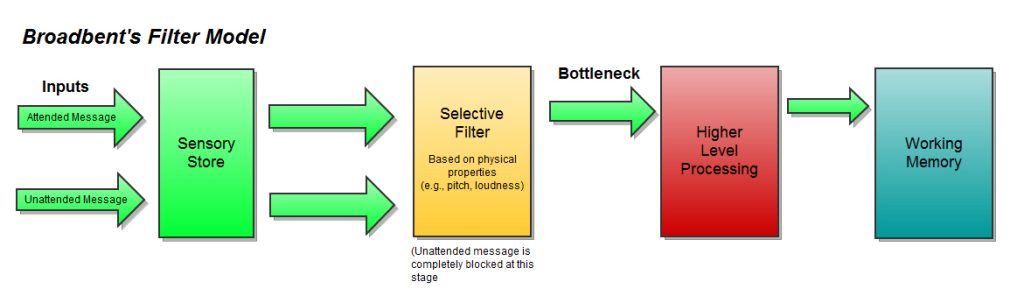
  • Brand Luxury Scale

    The Brand Luxury Index (BLI) is a tool designed to measure consumers’ perceptions of luxury brands[1]. Developed by researchers Jean-Noël Kapferer and Vincent Bastien, the BLI assesses various aspects of a brand’s luxury status through seven sub-categories[1].

    Components of the BLI

    The BLI consists of seven key dimensions:

    1. Price
    2. Aesthetics
    3. Exclusivity
    4. Client Relationship
    5. Social Status
    6. Hedonism
    7. Quality

    Each dimension is scored on a scale of 0-10, with a total possible score of 70[1].

    Scoring and Interpretation

    The scoring rules vary slightly for different sub-categories:

    • For most sub-categories, higher scores indicate higher levels of luxury[1].
    • The Client Relationship category is reverse-scored, where lower scores indicate higher luxury[1].

    Survey Questions

    The BLI survey includes questions for each dimension. Here are some example statements for each category:

    Price

    • The brand’s products are highly priced.
    • The brand’s pricing reflects its exclusivity.

    Aesthetics

    • The brand’s products are visually appealing.
    • The brand’s designs are aesthetically pleasing.

    Exclusivity

    • The brand’s products are not easily accessible to everyone.
    • Owning this brand’s products makes me feel unique.

    Client Relationship

    • The brand provides excellent customer service.
    • The brand has a personal connection with its customers.

    Social Status

    • Owning a product from this brand is a status symbol.
    • The brand is associated with high social status and prestige.

    Hedonism

    • The brand’s products provide a luxurious and indulgent experience.
    • Owning a product from this brand is a form of self-indulgence.

    Quality

    • The brand’s products are of exceptional quality.
    • The brand uses the best materials and craftsmanship[1].

    Criticisms and Limitations

    Despite its widespread use, the BLI has faced some criticism:

    1. Subjectivity: The scale relies heavily on consumer perceptions, which can be subjective[1].
    2. Lack of objective measures: It does not account for tangible aspects of luxury such as materials or craftsmanship[1].
    3. Limited applicability: Some researchers argue that the BLI may not be suitable for all luxury brands, as different brands may prioritize different aspects of luxury[1].

    Revisions and Improvements

    Recognizing these limitations, researchers have proposed modifications to the original BLI. Kim and Johnson developed a revised version with five dimensions: quality, extended-self, hedonism, accessibility, and tradition[2]. This modified BLI aims to provide a more practical tool for assessing consumer perceptions of brand luxury[2].

    Conclusion

    The Brand Luxury Index Scale remains a valuable tool for measuring consumer perceptions of luxury brands. While it has limitations, ongoing research and revisions continue to improve its effectiveness and applicability in the ever-evolving luxury market.

    Citations:
    [1] https://researchmethods.imem.nl/CB/index.php/research/concept-scales-and-quationaires/123-brand-luxury-index-scale-bli
    [2] https://www.emerald.com/insight/content/doi/10.1108/JFMM-05-2015-0043/full/html
    [3] https://premierdissertations.com/luxury-marketing-and-branding-an-evaluation-under-bli-brand-luxury-index/
    [4] https://www.proquest.com/docview/232489076
    [5] https://www.researchgate.net/publication/247478622_Measuring_perceived_brand_luxury_An_evaluation_of_the_BLI_scale
    [6] https://www.researchgate.net/publication/31968013_Measuring_perceptions_of_brand_luxury
    [7] https://www.deepdyve.com/lp/emerald-publishing/brand-luxury-index-a-reconsideration-and-revision-dOTwPEUCxt

  • Brand Parity Scale

    Brand parity is a phenomenon where consumers perceive multiple brands in a product category as similar or interchangeable[1]. This concept has significant implications for marketing strategies and consumer behavior. To measure brand parity, researchers have developed scales to quantify consumers’ perceptions of brand similarity.

    The Brand Parity Scale

    James A. Muncy developed a multi-item scale to measure perceived brand parity for consumer nondurable goods[3]. This scale has been widely used in marketing research to assess the level of perceived similarity among brands in a given product category.

    Scale Components

    The Brand Parity Scale typically includes items that assess various aspects of brand similarity, such as:

    1. Perceived quality differences
    2. Functional equivalence
    3. Brand interchangeability
    4. Uniqueness of brand features

    Survey Questions

    While the exact questions from Muncy’s original scale are not provided in the search results, typical items on a brand parity scale might include:

    1. “The quality of most brands in this product category is basically the same.”
    2. “I can’t tell the difference between the major brands in this category.”
    3. “Most brands in this category are essentially identical.”
    4. “Switching between brands in this category makes little difference.”
    5. “The features offered by different brands in this category are very similar.”

    Respondents usually rate these statements on a Likert scale, ranging from “Strongly Disagree” to “Strongly Agree.”

    Impact of Brand Parity

    High levels of perceived brand parity can have significant effects on consumer behavior and brand management:

    1. Reduced Brand Loyalty: When consumers perceive brands as similar, they are less likely to develop strong brand loyalty[4].
    2. Increased Price Sensitivity: Brand parity can lead to greater price sensitivity among consumers, as they may not see added value in paying more for a particular brand[1].
    3. Diminished Marketing Effectiveness: High brand parity can make it challenging for brands to differentiate themselves through marketing efforts[1].
    4. Impact on Repurchase Intention: Brand parity can moderate the relationship between brand-related factors (such as brand image and brand experience) and consumers’ repurchase intentions[2].

    Critiques and Limitations

    While Muncy’s Brand Parity Scale has been widely used, it has also faced some critiques:

    1. Context Specificity: The scale may need to be adapted for different product categories or markets[8].
    2. Evolving Consumer Perceptions: As markets change, the relevance of specific scale items may need to be reassessed[8].
    3. Cultural Differences: The scale may not account for cultural variations in brand perceptions across different regions or countries.

    Conclusion

    The Brand Parity Scale provides a valuable tool for marketers to assess the level of perceived similarity among brands in a product category. By understanding the degree of brand parity, companies can develop more effective strategies to differentiate their brands and create unique value propositions. As markets continue to evolve, ongoing research and refinement of brand parity measurement tools will be crucial for maintaining their relevance and effectiveness in guiding marketing decisions.

    Citations:
    [1] https://www.haveignition.com/what-is-gtm/the-go-to-market-dictionary-brand-parity
    [2] https://www.abacademies.org/articles/impact-of-brand-parity-on-brandrelated-factors-customer-satisfaction-repurchase-intention-continuum-an-empirical-study-on-brands-o-13401.html
    [3] https://openurl.ebsco.com/contentitem/gcd:83431944?crl=f&id=ebsco%3Agcd%3A83431944&sid=ebsco%3Aplink%3Ascholar
    [4] https://www.researchgate.net/publication/4733786_The_Role_of_Brand_Parity_in_Developing_Loyal_Customers
    [5] https://www.degruyter.com/document/doi/10.1515/econ-2022-0054/html?lang=en
    [6] https://researchmethods.imem.nl/CB/index.php/research/concept-scales-and-quationaires/137-brand-perception-scale
    [7] https://www.researchgate.net/publication/270158684_Differentiated_brand_experience_in_brand_parity_through_branded_branding_strategy
    [8] https://www.europub.co.uk/articles/perceived-brand-parity-critiques-on-muncys-scale-A-5584

  • Brand Personality Scale

    Jennifer Aaker’s Brand Personality Scale (BPS) is a widely used tool in marketing research to measure and quantify the personality traits associated with brands. Developed in 1997, the BPS identifies five key dimensions of brand personality: Sincerity, Excitement, Competence, Sophistication, and Ruggedness[1][2].

    The Five Dimensions

    Sincerity

    This dimension reflects traits such as honesty, wholesomeness, and cheerfulness. Brands scoring high in sincerity are often perceived as down-to-earth and genuine[2].

    Excitement

    Excitement encompasses traits like daring, spirited, and imaginative. Brands strong in this dimension are often seen as contemporary and youthful[2].

    Competence

    Competence relates to reliability, intelligence, and success. Brands excelling in this dimension are typically viewed as dependable and efficient[2].

    Sophistication

    This dimension includes traits such as upper class, charming, and glamorous. Sophisticated brands are often associated with luxury and prestige[2].

    Ruggedness

    Ruggedness reflects traits like outdoorsy, tough, and masculine. Brands strong in this dimension are often perceived as durable and adventurous[2].

    Survey Questions

    The BPS consists of 42 personality traits, with each dimension measured by specific items. Respondents rate each trait on a 7-point Likert scale. Here are some example items for each dimension[2]:

    Sincerity:

    • Down-to-earth
    • Honest
    • Wholesome
    • Cheerful

    Excitement:

    • Daring
    • Spirited
    • Imaginative
    • Up-to-date

    Competence:

    • Reliable
    • Intelligent
    • Successful
    • Technical

    Sophistication:

    • Upper class
    • Charming
    • Feminine
    • Elegant

    Ruggedness:

    • Outdoorsy
    • Tough
    • Masculine
    • Western

    Significance and Applications

    The BPS has become a fundamental tool in brand management and consumer behavior research. It allows marketers to:

    1. Quantify brand perceptions
    2. Compare brand personalities across different markets
    3. Align brand strategy with consumer perceptions
    4. Differentiate brands within competitive markets

    Limitations and Criticisms

    Despite its widespread use, the BPS has faced some criticisms:

    1. Cultural limitations: The scale was developed in the United States and may not fully capture brand personalities in other cultures[2].
    2. Interdependence of dimensions: Some argue that the five dimensions are not entirely independent of each other[2].
    3. Complexity: Critics suggest that the scale may not adequately capture the full complexity of brand personality[2].

    In conclusion, while the Brand Personality Scale has its limitations, it remains a valuable tool for understanding and measuring brand perceptions. Its five dimensions provide a framework for brands to differentiate themselves and connect with consumers on a more personal level.

    Citations:
    [1] https://journals.sagepub.com/doi/pdf/10.1177/0256090920080304
    [2] http://researchmethods.imem.nl/CB/index.php/research/concept-scales-and-quationaires/125-brand-personality-scale-bps
    [3] https://papers.ssrn.com/sol3/papers.cfm?abstract_id=945432
    [4] https://essay.utwente.nl/76375/1/DANIEL_MA_BMS.pdf
    [5] https://howbrandsarebuilt.com/some-thoughts-about-brand-personality/
    [6] https://liveinnovation.org/brand-personality-understanding-aakers-5-dimension-model/
    [7] https://www.sciencedirect.com/science/article/pii/S0019850111001313
    [8] https://www.researchgate.net/publication/32011287_Do_brand_personality_scales_really_measure_brand_personality

  • Brand Experience Scale

    The Brand Experience Scale, developed by Brakus, Schmitt, and Zarantonello in 2009, is a significant contribution to the field of marketing and brand management. This scale provides a comprehensive framework for measuring and understanding how consumers experience brands across multiple dimensions.

    Conceptualization of Brand Experience

    Brand experience is defined as the sensations, feelings, cognitions, and behavioral responses evoked by brand-related stimuli[1][3]. These stimuli can include a brand’s design, identity, packaging, communications, and environments. The concept goes beyond traditional brand measures, focusing on the subjective, internal consumer responses to brand interactions.

    Dimensions of Brand Experience

    The Brand Experience Scale comprises four key dimensions:

    1. Sensory: How the brand appeals to the five senses
    2. Affective: Emotions and feelings evoked by the brand
    3. Intellectual: The brand’s ability to engage consumers in cognitive and creative thinking
    4. Behavioral: Physical actions and behaviors induced by the brand

    Scale Development and Validation

    The authors conducted six studies to develop and validate the Brand Experience Scale[3]. They began with a large pool of items, which were then refined through exploratory factor analysis. The final scale was validated using confirmatory factor analysis and structural equation modeling.

    Importance and Applications

    The Brand Experience Scale offers several advantages:

    1. Reliability and validity: The scale has demonstrated strong psychometric properties across multiple studies[1][3].
    2. Distinctiveness: It is distinct from other brand measures such as brand evaluations, involvement, and personality[2].
    3. Predictive power: Brand experience has been shown to affect consumer satisfaction and loyalty both directly and indirectly[3].

    Implications for Marketing Practice

    Marketers can use the Brand Experience Scale to:

    1. Assess the effectiveness of brand-related stimuli
    2. Compare brand experiences across different products or services
    3. Identify areas for improvement in brand strategy
    4. Predict consumer behavior and loyalty

    Brand Experience Questionnaire

    The following is the Brand Experience Scale questionnaire, using a 7-point Likert scale (1 = strongly disagree, 7 = strongly agree)[3]:

    Sensory Dimension:

    1. This brand makes a strong impression on my visual sense or other senses.
    2. I find this brand interesting in a sensory way.
    3. This brand does not appeal to my senses.

    Affective Dimension:

    1. This brand induces feelings and sentiments.
    2. I do not have strong emotions for this brand.
    3. This brand is an emotional brand.

    Intellectual Dimension:

    1. I engage in a lot of thinking when I encounter this brand.
    2. This brand does not make me think.
    3. This brand stimulates my curiosity and problem solving.

    Behavioral Dimension:

    1. I engage in physical actions and behaviors when I use this brand.
    2. This brand results in bodily experiences.
    3. This brand is not action oriented.

    By utilizing this scale, marketers and researchers can gain valuable insights into how consumers experience and interact with brands, ultimately leading to more effective brand management strategies.

    Citations:
    [1] http://essay.utwente.nl/82847/1/Schrotenboer_MA_BMS.pdf
    [2] https://papers.ssrn.com/sol3/papers.cfm?abstract_id=1960358
    [3] https://business.columbia.edu/sites/default/files-efs/pubfiles/4243/Brand%20Experience%20and%20Loyalty_Journal_of%20_Marketing_May_2009.pdf
    [4] https://www.ntnu.no/documents/10401/1264433962/KatrineArtikkel.pdf/963893af-2047-4e52-9f5b-028ef4799cb7
    [5] https://www.emerald.com/insight/content/doi/10.1108/jpbm-07-2015-0943/full/html
    [6] https://jcsdcb.com/index.php/JCSDCB/article/download/117/160
    [7] https://link.springer.com/article/10.1057/bm.2010.4
    [8] https://journals.sagepub.com/doi/10.1509/jmkg.73.3.052

  • The Emotional Attachment Scale

    The Emotional Attachment Scale (EAS) is a tool used in media and marketing research to measure emotional attachment and brand loyalty. The scale was developed by Thomson, MacInnis, and Park (2005) and has been widely used in various fields, including advertising, consumer behavior, and psychology.

    The EAS consists of three sub-scales: affection, connection, and passion. Each sub-scale includes five items, resulting in a total of 15 items. Participants rate their level of agreement with each statement on a 7-point Likert scale, ranging from 1 (strongly disagree) to 7 (strongly agree).

    The affection sub-scale measures the emotional bond that a person has with a brand or product. The connection sub-scale assesses the extent to which a person feels a personal connection with the brand or product. The passion sub-scale evaluates the intensity of a person’s emotional attachment to the brand or product.

    Example statements from the EAS include:

    • “I feel affection for this brand/product”
    • “This brand/product is personally meaningful to me”
    • “I would be very upset if this brand/product were no longer available”

    To score the EAS, the responses to the five items in each sub-scale are summed. For the affection and connection sub-scales, higher scores indicate a stronger emotional attachment to the brand or product. For the passion sub-scale, higher scores indicate a more intense emotional attachment to the brand or product.

    However, it is important to note that some of the items in the EAS are reverse-scored, meaning that a response of 1 is equivalent to a response of 7 on the Likert scale. For example, the statement “I would feel very upset if this brand/product were no longer available” is reverse-scored, so a response of 7 indicates a weaker emotional attachment, while a response of 1 indicates a stronger emotional attachment.

    While the EAS has been widely used and validated in previous research, it is not without criticisms. Some researchers have argued that the EAS is limited in its ability to capture the complexity of emotional attachment and brand loyalty, and that additional measures may be needed to fully understand these constructs (Batra, Ahuvia, & Bagozzi, 2012). Others have suggested that the EAS may be too focused on the affective aspects of attachment and may not fully capture the behavioral aspects of brand loyalty (Oliver, 1999).

    Overall, the EAS can provide valuable insights into consumers’ emotional attachment to brands and products, but it is important to use it in conjunction with other measures to fully understand these constructs.

    the complete questionnaire for the Emotional Attachment Scale (EAS):

    Affection Sub-Scale:

    1. I feel affection for this brand/product.
    2. This brand/product makes me feel good.
    3. I have warm feelings toward this brand/product.
    4. I am emotionally attached to this brand/product.
    5. I love this brand/product.

    Connection Sub-Scale:

    1. This brand/product is personally meaningful to me.
    2. This brand/product is part of my life.
    3. I can relate to this brand/product.
    4. This brand/product reflects who I am.
    5. This brand/product is important to me.

    Passion Sub-Scale:

    1. I am enthusiastic about this brand/product.
    2. This brand/product excites me.
    3. I have a strong emotional bond with this brand/product.
    4. I am deeply committed to this brand/product.
    5. I would be very upset if this brand/product were no longer available.

    Participants rate their level of agreement with each statement on a 7-point Likert scale, ranging from 1 (strongly disagree) to 7 (strongly agree).

    To score the EAS, the responses to the five items in each sub-scale are summed. For the affection and connection sub-scales, higher scores indicate a stronger emotional attachment to the brand or product. For the passion sub-scale, higher scores indicate a more intense emotional attachment to the brand or product. However, it is important to note that some of the items in the EAS are reverse-scored, meaning that a response of 1 is equivalent to a response of 7 on the Likert scale.

  • Scales that can be adapted to measure the quality of a Magazine

    Quality assessment scales that could potentially be adapted for magazine evaluation:

    CGC Grading Scale

    The Certified Guaranty Company (CGC) uses a 10-point grading scale to evaluate collectibles, including magazines[1]. This scale includes:

    1. Standard Grading Scale
    2. Page Quality Scale
    3. Restoration Grading Scale

    The Restoration Grading Scale assesses both quality and quantity of restoration work[1].

    Literature Quality Assessment Tools

    While not specific to magazines, these tools could potentially be adapted:

    1. CASP Qualitative Checklist
    2. CASP Systematic Review Checklist
    3. Newcastle-Ottawa Scale (NOS)
    4. Cochrane Risk of Bias (RoB) Tool
    5. Quality Assessment Tool for Quantitative Studies (QATQS)
    6. Jadad Scale[2]

    Impact Factor

    The impact factor (IF) or journal impact factor (JIF) is a scientometric index used to reflect the yearly mean number of citations of articles published in academic journals[4]. While primarily used for academic publications, this concept could potentially be adapted for magazines.

    Customer Experience (CX) Scales

    Two scales used in customer experience research that could be relevant for magazine quality assessment:

    1. Best Ever Scale: A nine-point scale comparing the product or service to historical best or worst experiences[5].
    2. Stated Improvement Scale: A five-point scale assessing the need for improvement[5].

    While these scales are not specifically designed for magazine quality evaluation, they provide insights into various approaches to quality assessment that could be adapted for magazine evaluation.

    Citations:
    [1] https://www.cgccomics.com/grading/grading-scale/
    [2] https://bestdissertationwriter.com/6-literature-quality-assessment-tools-in-systematic-review/
    [3] https://www.healthevidence.org/documents/our-appraisal-tools/quality-assessment-tool-dictionary-en.pdf
    [4] https://en.wikipedia.org/wiki/Impact_factor
    [5] https://www.quirks.com/articles/data-use-introducing-two-new-scales-for-more-comprehensive-cx-measurement
    [6] https://pmc.ncbi.nlm.nih.gov/articles/PMC10542923/
    [7] https://measuringu.com/rating-scales/
    [8] https://mmrjournal.biomedcentral.com/articles/10.1186/s40779-020-00238-8

  • Engagement Scale

    The Engagement Scale for a Free-Time Magazine is based on the concept of audience engagement, which is defined as the level of involvement and interaction between the audience and a media product (Kim, Lee, & Hwang, 2017). Audience engagement is important because it can lead to increased loyalty, satisfaction, and revenue for media organizations (Bakker, de Vreese, & Peters, 2013). In the context of a free-time magazine, audience engagement can be measured by factors such as personal interest, quality of content, relevance to readers’ lives, enjoyment of reading, visual appeal, length of articles, and frequency of publication.

    References:

    Bakker, P., de Vreese, C. H., & Peters, C. (2013). Good news for the future? Young people, internet use, and political participation. Communication Research, 40(5), 706-725.

    Kim, J., Lee, J., & Hwang, J. (2017). Building brand loyalty through managing audience engagement: An empirical investigation of the Korean broadcasting industry. Journal of Business Research, 75, 84-91.

    Questions 

    Engagement Scale for a Free-Time Magazine:

    1. Personal interest level:
    • Extremely interested
    • Very interested
    • Somewhat interested
    • Not very interested
    • Not at all interested
    1. Quality of content:
    • Excellent
    • Good
    • Fair
    • Poor
    1. Relevance to your life:
    • Extremely relevant
    • Very relevant
    • Somewhat relevant
    • Not very relevant
    • Not at all relevant
    1. Enjoyment of reading:
    • Very enjoyable
    • Somewhat enjoyable
    • Not very enjoyable
    • Not at all enjoyable
    1. Visual appeal:
    • Very appealing
    • Somewhat appealing
    • Not very appealing
    • Not at all appealing
    1. Length of articles:
    • Just right
    • Too short
    • Too long
    1. Frequency of publication:
    • Just right
    • Too frequent
    • Not frequent enough

    Subcategories:

    • Variety of topics:
      • Excellent
      • Good
      • Fair
      • Poor
    • Writing quality:
      • Excellent
      • Good
      • Fair
      • Poor
    • Usefulness of information:
      • Extremely useful
      • Very useful
      • Somewhat useful
      • Not very useful
      • Not at all useful
    • Originality:
      • Very original
      • Somewhat original
      • Not very original
      • Not at all original
    • Engagement with readers:
      • Excellent
      • Good
      • Fair
      • Poor
  • Digital Presence Scale

    The Digital Presence Scale is a measurement tool that assesses the digital presence of a brand or organization. It evaluates a brand’s performance in terms of digital marketing, social media, website design, and other digital channels. Here is the complete Digital Presence Scale for a magazine, including the questionnaire, sub-categories, scoring, and references:

    Questionnaire:

    1. Does the magazine have a website?
    2. Is the website responsive and mobile-friendly?
    3. Is the website design visually appealing and easy to navigate?
    4. Does the website have a clear and concise mission statement?
    5. Does the website have a blog or content section?
    6. Does the magazine have active social media accounts (e.g., Facebook, Twitter, Instagram, etc.)?
    7. Does the magazine regularly post content on their social media accounts?
    8. Does the magazine engage with their followers on social media (e.g., responding to comments and messages)?
    9. Does the magazine have an email newsletter or mailing list?
    10. Does the magazine have an e-commerce platform or online store?

    Sub-categories:

    1. Website design and functionality
    2. Website content and messaging
    3. Social media presence and engagement
    4. Email marketing and communication
    5. E-commerce and digital revenue streams

    Scoring:

    For each question, the magazine can score a maximum of 2 points. A score of 2 indicates that the magazine fully meets the criteria, while a score of 1 indicates partial compliance, and a score of 0 indicates non-compliance.

    References:

    The Digital Presence Scale is a measurement tool developed by the International Journal of Information Management. The sub-categories and questions for a magazine were adapted from existing literature on digital marketing and media.

  • Brand Attitude Scale

    Introduction:

    Brand attitude refers to the overall evaluation of a brand based on the individual’s beliefs, feelings, and behavioral intentions towards the brand. It is an essential aspect of consumer behavior and marketing, as it influences the purchase decisions of consumers. In this essay, we will explore the concept of brand attitude, its sub-concepts, and how it is measured. We will also discuss criticisms and limitations of this concept.

    Sub-Concepts of Brand Attitude:

    The sub-concepts of brand attitude include cognitive, affective, and conative components. The cognitive component refers to the beliefs and knowledge about the brand, including its features, attributes, and benefits. The affective component represents the emotional response of the consumer towards the brand, such as feelings of liking, disliking, or indifference. Finally, the conative component represents the behavioral intention of the consumer towards the brand, such as the likelihood of buying or recommending the brand to others.

    Measurement of Brand Attitude:

    There are several ways to measure brand attitude, including self-report measures, behavioral measures, and physiological measures. Self-report measures are the most common method of measuring brand attitude and involve asking consumers to rate their beliefs, feelings, and behavioral intentions towards the brand using a Likert scale or other rating scales.

    One of the most widely used self-report measures of brand attitude is the Brand Attitude Scale (BAS), developed by Richard Lutz in 1975. The BAS is a six-item scale that measures the cognitive, affective, and conative components of brand attitude. Another commonly used measure is the Brand Personality Scale (BPS), developed by Jennifer Aaker in 1997, which measures the personality traits associated with a brand.

    Criticism of Brand Attitude:

    One criticism of brand attitude is that it is too simplistic and does not account for the complexity of consumer behavior. Critics argue that consumers’ evaluations of brands are influenced by a wide range of factors, including social and cultural factors, brand associations, and personal values. Therefore, brand attitude alone may not be sufficient to explain consumers’ behavior towards a brand.

    Another criticism of brand attitude is that it may be subject to social desirability bias. Consumers may give socially desirable responses to questions about their attitude towards a brand, rather than their genuine beliefs and feelings. This bias may result in inaccurate measurements of brand attitude.

    Conclusion:

    Brand attitude is an essential concept in consumer behavior and marketing. It refers to the overall evaluation of a brand based on the individual’s beliefs, feelings, and behavioral intentions towards the brand. The sub-concepts of brand attitude include cognitive, affective, and conative components. There are several ways to measure brand attitude, including self-report measures, behavioral measures, and physiological measures. The Brand Attitude Scale (BAS) and the Brand Personality Scale (BPS) are two commonly used measures of brand attitude. However, the concept of brand attitude is not without its criticisms, including its simplicity and susceptibility to social desirability bias. Despite these criticisms, brand attitude remains a valuable concept for understanding consumer behavior and developing effective marketing strategies.

    References:

    Aaker, J. (1997). Dimensions of brand personality. Journal of marketing research, 34(3), 347-356.

    Lutz, R. J. (1975). Changing brand attitudes through modification of cognitive structure. Journal of consumer research, 1(4), 49-59.

    Punj, G. N., & Stewart, D. W. (1983). An interactionist approach to the theory of brand choice. Journal of Consumer Research, 10(3), 281-299.

    Questionaire

    The Brand Attitude Scale (BAS) is a self-report measure used to assess the cognitive, affective, and conative components of brand attitude. The scale consists of six items, each rated on a seven-point Likert scale ranging from 1 (strongly disagree) to 7 (strongly agree). The complete BAS is as follows:

    1. I believe that the [brand name] is a high-quality product.
    2. I feel positive about the [brand name].
    3. I would recommend the [brand name] to others.
    4. I have confidence in the [brand name].
    5. I trust the [brand name].
    6. I would consider buying the [brand name] in the future.

    To score the BAS, the scores for each item are summed, with higher scores indicating a more positive brand attitude. The possible range of scores on the BAS is from 6 to 42, with higher scores indicating a more positive brand attitude. The reliability and validity of the BAS have been established in previous research, making it a widely used and validated measure of brand attitude.

  • Mindful Attention Awareness Scale (MAAS)

    Mindfulness has become an increasingly popular concept in recent years, as people strive to find ways to reduce stress, increase focus, and improve their overall wellbeing. One of the most widely used tools for measuring mindfulness is the Mindful Attention Awareness Scale (MAAS), developed by J. Brown and R. Ryan in 2003. In this blog post, we will explore the MAAS and its different scales to help you better understand how it can be used to measure mindfulness.

    The MAAS is a 15-item scale designed to measure the extent to which individuals are able to maintain a non-judgmental and present-focused attention to their thoughts and sensations in daily life. The scale consists of statements that are rated on a six-point scale ranging from 1 (almost always) to 6 (almost never). Respondents are asked to indicate how frequently they have experienced each statement over the past week.

    The MAAS is divided into three subscales, which can be used to measure different aspects of mindfulness. The first subscale is the Attention subscale, which measures the extent to which individuals are able to maintain their focus on the present moment. The second subscale is the Awareness subscale, which measures the extent to which individuals are able to notice their thoughts and sensations without judging them. The third subscale is the Acceptance subscale, which measures the extent to which individuals are able to accept their thoughts and feelings without trying to change them.

    Each subscale of the MAAS consists of five items. Here are the items included in each subscale:

    Attention Subscale:

    1. I find myself doing things without paying attention.
    2. I drive places on “automatic pilot” and then wonder why I went there.
    3. I find myself easily distracted during tasks.
    4. I tend not to notice feelings of physical tension or discomfort until they really grab my attention.
    5. I rush through activities without being really attentive to them.

    Awareness Subscale:

    1. I could be experiencing some emotion and not be conscious of it until sometime later.
    2. I break or spill things because of carelessness, not paying attention, or thinking of something else.
    3. I find it difficult to stay focused on what’s happening in the present.
    4. I find myself preoccupied with the future or the past.
    5. I find myself listening to someone with one ear, doing something else at the same time.

    Acceptance Subscale:

    1. I tell myself that I shouldn’t be feeling the way that I’m feeling.
    2. When I fail at something important to me I become consumed by feelings of inadequacy.
    3. When I’m feeling down I tend to obsess and fixate on everything

    Awareness Subscale:

    1. I could be experiencing some emotion and not be conscious of it until sometime later.
    2. I break or spill things because of carelessness, not paying attention, or thinking of something else.
    3. I find it difficult to stay focused on what’s happening in the present.
    4. I find myself preoccupied with the future or the past.
    5. I find myself listening to someone with one ear, doing something else at the same time.

    Acceptance Subscale:

    1. I tell myself that I shouldn’t be feeling the way that I’m feeling.
    2. When I fail at something important to me I become consumed by feelings of inadequacy.
    3. When I’m feeling down I tend to obsess and fixate on everything